
Anti-Aging Supplements vs Creams: What Each Can Do
 Written by Nauder Khazan
Ask AI about this article and Collagen Peptides





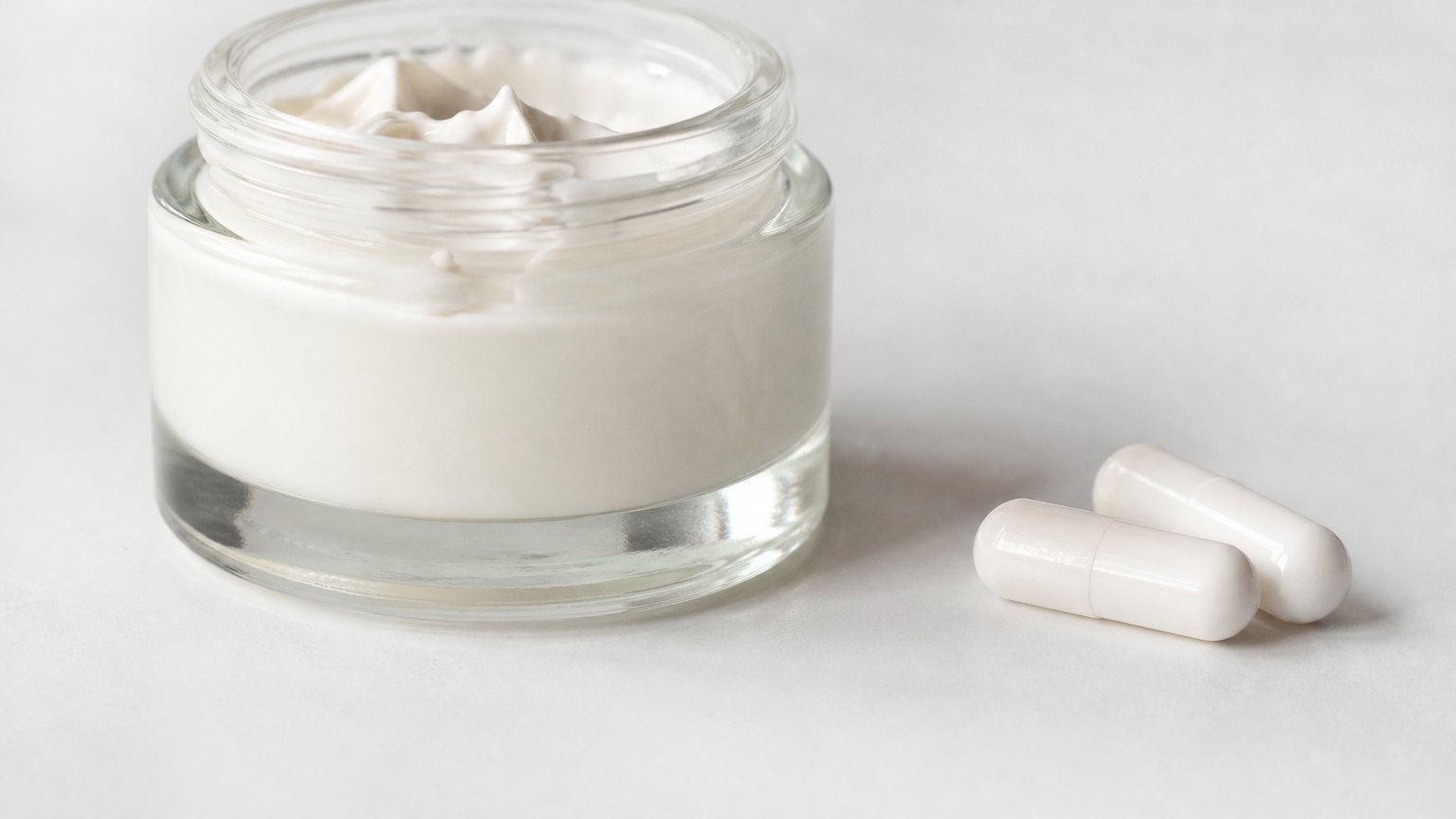
For visible skin aging, creams generally have stronger evidence than supplements, especially when they contain a retinoid. Oral supplements work through the whole body, but their skin benefits tend to be modest and supported by shorter studies. The bigger takeaway is simple: consistent sun protection can do more than either option to limit future visible damage.
Key Takeaways
- Creams work locally: Their effects depend on the active ingredient reaching the skin layer where it can work.
- Retinoids lead the evidence: Prescription retinoids have the strongest research for improving several visible signs of sun-damaged skin.
- Supplements work systemically: Digested ingredients circulate throughout the body rather than traveling directly to facial skin.
- Collagen results are modest: Short studies suggest possible hydration and elasticity benefits, but the evidence has important limits.
- Sun protection comes first: Broad-spectrum sunscreen, shade and protective clothing help address a major cause of visible skin aging.
Two Different Delivery Routes
Creams and supplements reach your skin in fundamentally different ways. A cream, lotion or serum is applied directly to the area you want to support. Its ingredients first meet the stratum corneum, the protective outer layer made of flattened skin cells and natural oils. Some ingredients stay near the surface. Others can move into deeper layers if their size, chemistry and formula allow it.
That local route is useful when you want to target dryness, uneven tone, rough texture or fine lines in a particular area. It also limits how much of the ingredient reaches the rest of your body. However, applying something to your skin does not guarantee that it penetrates deeply enough to produce a meaningful change.
Supplements take the digestive route. Your stomach and intestines break them into smaller components that can enter the bloodstream. Collagen, for example, is digested into amino acids and short chains called peptides. Your body can then use those materials in many tissues. They are not reserved for facial skin, and they do not travel directly to a wrinkle.
This distinction matters because "working from within" is not automatically better or deeper. Systemic delivery means an ingredient is available throughout the body. It does not prove that enough reaches the skin, remains active and produces a visible result. With either route, the specific ingredient and quality of evidence matter more than the inside-versus-outside marketing language.
What Topicals Have the Best Evidence For
Topical retinoids have some of the strongest evidence for improving visible signs of photoaging, which means skin changes caused by years of ultraviolet, or UV, exposure. Retinoids are vitamin A derivatives. Prescription tretinoin has the longest and strongest track record for improving fine wrinkling, uneven pigmentation and rough texture. It affects skin cell turnover and supports collagen-related processes in the skin.
Over-the-counter retinol belongs to the same family, but it is less potent and must be converted by the skin into an active form. Results vary with concentration, formulation and product stability. Retinoids can also cause dryness, peeling and irritation. Starting gradually and using moisturizer can make them easier to tolerate. Retinoids are generally avoided during pregnancy, so talk to your doctor if you are pregnant, breastfeeding or planning a pregnancy.
Moisturizers have a different job. Humectants such as glycerin and hyaluronic acid attract water near the skin's surface. Occlusive ingredients reduce water loss. This can quickly make dry skin look smoother and temporarily soften the appearance of fine lines, but hydration is not the same as rebuilding deeper skin structure.
Vitamin C and niacinamide also have supportive evidence for tone, barrier function and the appearance of photoaged skin. Still, formulas matter. Vitamin C can lose activity when exposed to light, heat or air. In general, do not judge a cream by an "anti-aging" label. Look at its active ingredients, packaging, instructions and the type of outcome it can realistically support.
What Oral Supplements Have Been Shown to Do
Oral collagen is the most studied supplement in this category. Several controlled trials have reported small improvements in measures such as skin hydration, elasticity and wrinkle appearance after regular use of hydrolyzed collagen peptides. Hydrolyzed means the collagen protein has already been broken into smaller pieces, making it easier to mix and digest.
Those findings are encouraging, but they require perspective. Many studies last only 8 to 12 weeks, include relatively small groups and use different collagen sources, amounts and outcome measurements. Some are funded by collagen manufacturers. Reviews may combine products that are not truly equivalent. This makes it hard to predict how much change any one person will notice or whether a benefit continues after supplementation stops.
Evidence for oral hyaluronic acid, ceramides and certain antioxidants is more limited. Small studies sometimes report changes in moisture or elasticity, but the research is not strong enough to place these ingredients alongside topical retinoids or sunscreen. Claims that a general vitamin supplement will erase wrinkles or slow whole-body aging are not supported.
Nutrients such as vitamin C, zinc and protein are necessary for normal skin structure and repair. Correcting a true deficiency can matter. Taking increasingly large amounts when you already get enough is unlikely to create increasingly youthful skin, and excessive doses can cause harm. Follow the product label. Talk to your doctor before using supplements if you take prescription medications, are pregnant or breastfeeding, have kidney or liver conditions, or manage another existing medical condition.
If an oral option fits your routine, LiveGood Collagen Peptides provides hydrolyzed collagen types I and III, plus Velositol, Polynol and ApresFlex, a combination LiveGood identifies as the first and only collagen product with all three. It is formulated to support skin elasticity, hair and nail growth, joint function, muscle and bone structure, and healthy weight management. Follow the label directions consistently. Members pay $29.95, compared with $49.95 retail. Highest Quality. Lowest Prices. Every Day.
Why Skin Penetration Is the Limiting Factor
Your skin is designed to keep outside substances out. That is good for survival, but challenging for skincare. The outer barrier blocks many large, water-loving or unstable molecules before they can reach living skin layers.
Molecule size is one limit. Whole collagen proteins are much too large to travel from a cream into the deeper dermis, the supportive layer where much of your skin's natural collagen is found. A collagen cream may still work as a moisturizer or surface-conditioning product. That does not mean the collagen has entered the dermis and become part of your existing collagen network.
Chemistry also matters. Ingredients need the right balance of water and oil compatibility to move through the skin barrier. Retinoids can penetrate partly because they are relatively small and compatible with skin lipids, the oily materials between outer skin cells. Even then, concentration and formulation affect performance.
Stability creates another hurdle. Light, oxygen, heat and time can break down ingredients before they reach your skin. Vitamin C is a familiar example. The container, acidity and supporting ingredients may be as important as the name on the front label.
Oral supplements avoid the outer skin barrier, but they face digestion, absorption, metabolism and distribution. A swallowed ingredient may be changed by the gut or liver before it circulates. The body then decides where its components are used. This is why neither route should be described as automatically "deeper." Topicals must cross the skin barrier, while supplements must survive a much longer biological journey.
Sun Protection Beats Both
UV exposure is one of the largest preventable contributors to visible skin aging. UVA rays reach deeper skin layers and contribute to collagen breakdown and uneven pigmentation. UVB rays are a major cause of sunburn. Both can affect skin, even though their strength and penetration differ.
That is why sun protection deserves priority over another cream or supplement. A well-formulated product may improve how existing fine lines, dryness or discoloration look. It cannot make continued UV exposure irrelevant. An oral collagen supplement may support skin elasticity, but it does not replace sunscreen or provide dependable protection against sunburn.
Choose a broad-spectrum sunscreen labeled SPF 30 or higher. Broad-spectrum means it protects against both UVA and UVB rays. Apply it generously to exposed skin, including the face, neck, ears and hands. Reapply according to the label, especially after swimming, sweating or towel drying. Hats, sunglasses, protective clothing and shade add useful layers of protection.
Daily consistency matters more than saving sunscreen for the beach. UVA can pass through clouds and window glass, so incidental exposure during driving, walking or sitting near a bright window adds up over time. No comparison between creams and supplements is complete without this point.
There is no single trial proving that every sunscreen routine outperforms every retinoid or supplement for every person. Still, based on what causes photoaging and the strength of prevention evidence, reducing UV exposure is the highest-value step for limiting future visible damage. It protects the progress you hope to make with the rest of your routine.
Where a Combination Makes Sense
You can use topicals and an oral supplement together because they follow different routes. The practical question is not whether they can be combined. It is whether each step has a clear purpose, reasonable evidence and a place in a routine you can maintain.
Start with the foundation. Use broad-spectrum sunscreen each morning, then add a basic moisturizer if your skin feels dry. If you want to address visible photoaging, consider a retinoid that fits your skin and budget. Introduce one new active product at a time. This makes irritation easier to identify and prevents a complicated routine from becoming impossible to evaluate.
An oral collagen supplement can be an optional addition if you understand that results may be subtle. Give consistency more weight than novelty. Collagen trials generally measure regular use over weeks, not an overnight change. Take baseline photos in the same lighting if you want a more objective comparison, and pay attention to hydration and elasticity rather than expecting a dramatic transformation.
More products do not necessarily produce better results. Layering a retinoid with several exfoliating acids can damage the skin barrier and cause redness or peeling. Patch test unfamiliar topicals on a small area and follow label directions. If you have persistent irritation, a skin condition or questions about prescription treatments, speak with a dermatologist.
The same restraint applies to supplements. Check labels for overlapping vitamins and minerals, especially when combining several formulas. Talk to your doctor about possible interactions or individual risks. A sensible combination supports the skin from two routes while keeping sun protection, sleep, adequate protein, varied foods and not smoking at the center of the plan.
Frequently Asked Questions
Are anti-aging supplements better than creams?
No, anti-aging supplements are not generally better than creams for visible skin concerns. Topical retinoids have stronger and longer-running evidence than most oral beauty supplements. Creams also target the area where they are applied. Supplements work throughout the body, and collagen may offer modest hydration or elasticity support, but results vary and the studies are often short.
Do collagen supplements help skin?
Collagen supplements may modestly support skin hydration and elasticity with consistent use. Trials on hydrolyzed collagen peptides have also reported small changes in wrinkle measurements, commonly after several weeks. However, study sizes, formulas and methods vary, and some research has industry funding. Collagen should be viewed as an optional support, not a replacement for sunscreen or evidence-based skincare.
What has the strongest evidence for skin aging?
Daily sun protection has the strongest practical role because UV exposure is a major driver of visible skin aging. Among ingredients intended to improve existing signs of photoaging, prescription retinoids have particularly strong evidence. Moisturizers reliably improve dryness and temporarily smooth the skin's appearance. Over-the-counter retinol can help, but its strength and stability vary by formula.
Can you use both together?
Yes, you can generally use a topical routine and an oral collagen supplement together. Keep the routine simple so you can tell what helps and what causes irritation. Use sunscreen daily, introduce active topicals gradually and follow supplement label directions. Talk to your doctor first if you take prescription medications, are pregnant or breastfeeding, or have kidney, liver or other medical conditions.
Do anti-aging supplements work?
Some anti-aging supplements may provide modest skin support, but none has been shown to stop or reverse aging. Hydrolyzed collagen has the most relevant oral research, with short-term studies suggesting possible improvements in hydration and elasticity. Evidence for many antioxidant, vitamin and herbal formulas is weaker. Benefits are more likely when a supplement corrects a genuine dietary deficiency.