
Multi-Cat Households: What Owners Ask About CBD
 Written by Ben Glinsky

If your cats are fighting, stalking, or avoiding each other, CBD is not a proven solution. The most useful steps are to rule out illness, spread out essential resources, create safe escape routes, and use a slow reintroduction. Here is how to reduce tension without expecting a supplement to solve an environmental problem.
Key Takeaways
- Start with a veterinary exam: Sudden aggression or hiding can indicate pain or illness and warrants a veterinary exam.
- Separate essential resources: Give each cat safe access to food, water, litter trays, resting places, and scratching areas.
- Use the plus-one rule: Provide one litter tray and feeding station per cat, plus one extra, in different locations.
- Reintroduce cats gradually: Begin with physical separation, then exchange scents and build toward brief visual contact.
- Do not rely on CBD: No good evidence shows that CBD helps cats get along, and no CBD product is FDA-approved for animals.
Why Cats Fight or Avoid Each Other
Cats can share a home without belonging to the same social group. Two cats may tolerate each other in one room yet still compete over a doorway, favorite chair, or access to you. Peaceful coexistence is a reasonable goal. They do not need to cuddle or sleep together.
Common warning signs include staring, blocking hallways, chasing, swatting, hissing, hiding, and avoiding the litter tray. One cat may appear confident while the other quietly changes its routine. That quieter pattern still matters. A cat that waits until another cat leaves before eating or using the tray may not feel safe.
Conflict often begins after a change. A new cat, house move, visitor, building work, unfamiliar outdoor cat, or trip to the vet can make familiar surroundings smell and feel different. Age and activity levels matter too. A playful kitten can overwhelm an older cat that wants uninterrupted rest.
Pain and illness must also be considered. A cat that hurts may react when approached, while a sick cat may hide or become less tolerant. Sudden aggression or withdrawal is not simply bad behavior. It warrants a veterinary exam before you begin a behavior plan.

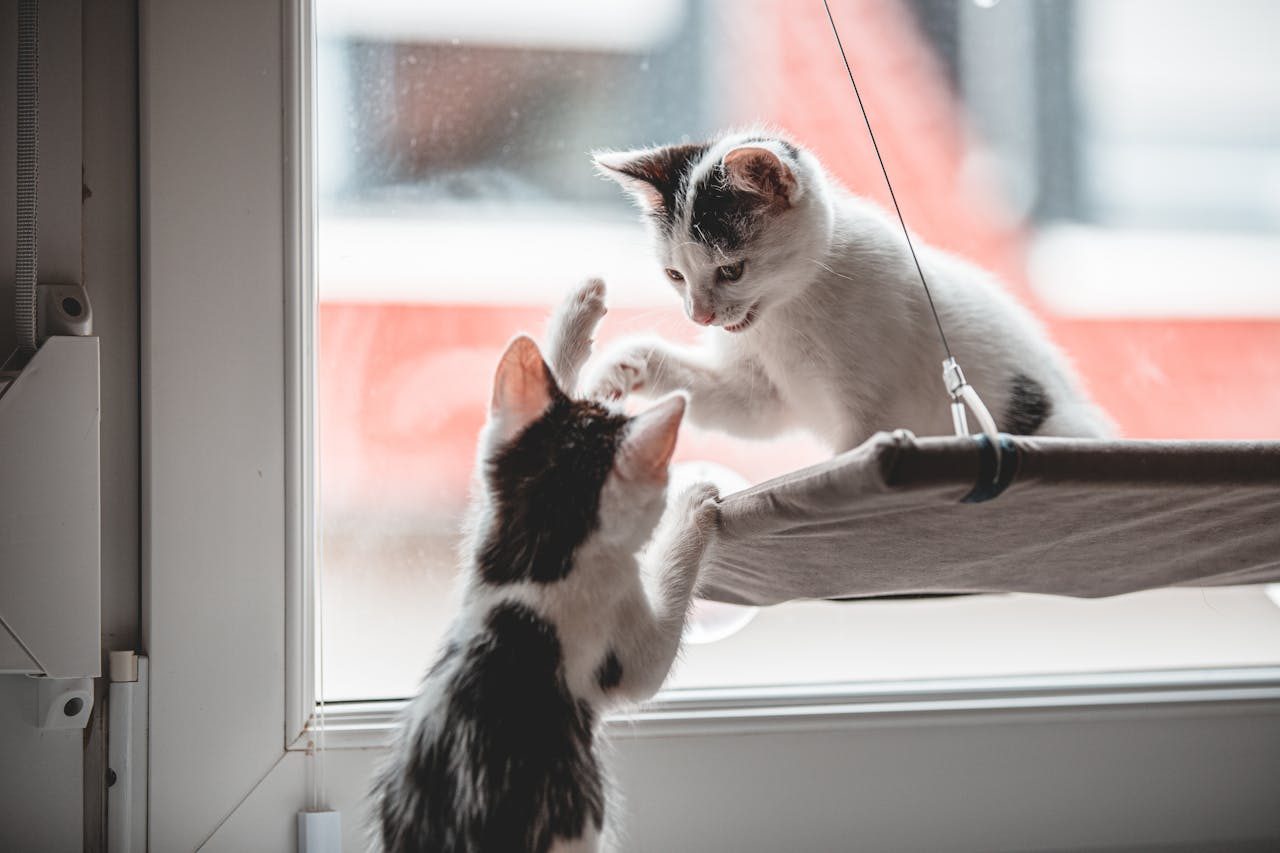
Watching where cats stare, block, chase, or retreat can help you identify the source of household tension.
Watch when and where tension occurs. A short written log can reveal whether conflict centers on food, litter trays, narrow passages, your attention, or a particular time of day.
Resources Are Usually the Root Cause
In cat behavior, a resource is anything a cat needs or values. This includes food, water, litter trays, sleeping areas, scratching posts, toys, hiding places, high perches, doorways, and time with you. Conflict often grows when cats must approach each other to reach these things.
A home can contain several bowls and beds but still create competition. For example, three food bowls placed side by side function like one feeding area. A nervous cat must enter the same space as the more confident cat. The same problem occurs when litter trays are lined up in one utility room or basement.
Spread resources through the home instead. Each cat should be able to eat, drink, rest, scratch, and use a litter tray without being watched or cornered by another cat. Choose quiet locations with more than one way out whenever possible. Avoid putting every valuable item at the end of a narrow hallway or behind a single doorway.
Food, water, litter trays, and resting places work best when they are distributed across separate areas.
Feed cats separately if one rushes, stares, steals food, or guards the room. Closed doors may be needed at first. Place water away from food and litter trays, and offer several water points. Add multiple resting places at different heights and in different rooms.
These changes may look simple, but they address the daily pressure that keeps conflict going. Supplements cannot fix a home where one cat controls access to basic needs.
The One-Per-Cat-Plus-One Rule
A useful starting point is one essential resource per cat, plus one extra. If you have two cats, aim for three litter trays and three separate feeding stations. With three cats, aim for four. The extra option reduces the chance that one cat can control every available location.
Location matters as much as number. Three litter trays placed next to one another may be experienced as a single toilet area. Put them in separate, quiet parts of the home. Each tray should be easy to enter and leave, without forcing a cat to pass another cat or enter a dead end.
Choose large trays and keep them clean. Many cats prefer uncovered trays because they provide better visibility and more than one direction of escape. A covered tray may work for some cats, but it can feel like a trap if another cat waits outside. Avoid suddenly changing every tray or litter type at once.
Apply the same principle to feeding. Separate stations do not have to operate around the clock, but each cat needs room to eat without staring or physical pressure. In some homes, feeding behind closed doors is the simplest answer. Timed or microchip feeders can also stop food stealing, although they do not replace adequate space.
The plus-one rule is a practical baseline, not a guarantee. A fearful cat may need a private room or additional options near its preferred resting area. Adjust the setup according to what your cats actually use.
Vertical Space and Escape Routes
Cats use height to observe their surroundings and avoid unwanted contact. Vertical space means usable areas above floor level, such as sturdy cat trees, shelves, window perches, and the tops of stable furniture. Adding height can expand a small home without changing its floor plan.

Multiple sturdy perches give cats more room to observe, rest, and avoid unwanted encounters.
Offer more than one high resting place. If there is only one prized perch, it can become another resource to guard. Place perches in different rooms and at different heights. Make sure older cats or cats with limited mobility can reach them through low steps or ramps rather than a difficult jump.
Escape routes are just as important. A cat should not have to squeeze past another cat to leave a room, reach a litter tray, or come down from a shelf. Look for bottlenecks such as narrow hallways, stair landings, and doorways. Furniture can sometimes be rearranged to provide a second path around these areas.
Hiding places help cats settle, but choose options with more than one opening when possible. A cardboard box with two cutout doors may feel safer than a single-entry cave during conflict. Never pull a hiding cat out to force an interaction.
Play can also reduce social pressure when it is offered separately. Use wand toys at a safe distance and let each cat finish with a small food reward. Do not encourage them to chase the same toy in close quarters until they are already comfortable sharing space.
Slow Reintroduction
When fights are repeated or one cat is hiding, start again with separation. Give each cat a secure area containing food, water, a litter tray, a bed, scratching material, toys, and places to hide. This is not punishment. It gives both cats time to eat, sleep, and use the tray without being monitored by the other.
Begin with scent exchange. Swap bedding or gently rub each cat's cheek with a separate soft cloth, then place the cloth near the other cat's area. Keep it far enough away that both cats remain relaxed. You can also switch rooms while the cats remain physically separated, allowing each to explore the other's scent.
Next, pair the other cat's presence with something pleasant. Feed on opposite sides of a closed door, beginning well back from the door. Over several sessions, move closer only if both cats keep eating and show loose, ordinary body language. Flattened ears, growling, fixed staring, crouching, or refusing food means you have moved too quickly.

A secure barrier allows brief visual contact while each cat keeps a comfortable distance.
Visual contact comes later. Use a tall gate, screen, or slightly opened secured door. Keep sessions brief and provide distance, treats, or gentle play. End while both cats are still settled. Increase time gradually before allowing supervised access to the same room.
A setback does not mean the process has failed. Return to the last comfortable stage. Never hold cats together, force nose-to-nose contact, or punish hissing. Reintroduction may take days, weeks, or longer. A certified feline behaviourist can tailor the pace when tension continues.
Where CBD Fits, and Where It Does Not
There is no reliable evidence that CBD helps cats get along. Feline research is minimal, and studies that examine safety or how cats process CBD do not prove that it improves aggression, fear, or relationships between cats. Established environmental and behavioral steps should remain the focus.
The FDA has approved no CBD product for animals. Epidiolex is the one FDA-approved CBD medicine, but it is a prescription drug approved for specific seizure disorders in humans. Its approval does not establish the safety or effectiveness of over-the-counter CBD products for cats.
Product quality is another concern. Independent testing has repeatedly found differences between CBD labels and actual contents. A product may contain more or less CBD than stated, and contamination with THC, pesticides, solvents, or other substances is possible. THC is hazardous to pets. Gummies and flavored human products may also contain ingredients that are inappropriate for cats.
CBD can interact with many medicines through cytochrome P450, often shortened to CYP450. This is a group of liver enzymes that helps process drugs. Changing that process may alter medication levels. Cats also handle many plant compounds differently from people. Essential oils and numerous botanicals can be hazardous to cats, so natural does not automatically mean safe.
Do not experiment with CBD doses or substitute it for a veterinary assessment. If you are considering any CBD product for a cat, speak with your veterinarian first. For questions involving your own prescriptions or CBD use, talk to your doctor or pharmacist.
When to Involve a Vet or Behaviourist
Arrange a veterinary exam promptly when aggression or hiding begins suddenly. Pain from dental problems, injury, arthritis, urinary trouble, digestive illness, or another health issue can change how a cat responds to touch and nearby animals. Changes in appetite, thirst, movement, grooming, sleep, litter tray use, or weight make an exam even more urgent.
Seek immediate veterinary help after a serious fight, especially if there are puncture wounds, limping, breathing changes, eye injuries, or ongoing bleeding. Small bite wounds can close over quickly and become infected beneath the skin. Keep the cats safely separated while you arrange care.
After medical causes have been assessed, a certified feline behaviourist can help identify triggers and build a home-specific plan. Ask about qualifications and methods. A good professional should use gradual, reward-based steps rather than punishment, spraying, startling, or forced contact. A veterinary behaviorist is a veterinarian with advanced training in behavior and can also assess whether prescription medication is appropriate.
Bring useful details to the appointment. Include when the problem began, where encounters occur, each cat's daily routine, and a map or photos showing food, water, litter trays, and resting areas. Short videos can help if recording does not put anyone at risk.
The goal is safety and reduced pressure, not instant friendship. Honest, evidence-grounded guidance matters here. Consistent environmental changes and a patient reintroduction offer a more dependable path than a quick-fix supplement.
Frequently Asked Questions
Does CBD help cats get along?
No, CBD has not been shown to help cats get along. Research in cats is very limited, and there is no solid evidence that CBD improves aggression or social behavior between household cats. Focus on veterinary screening, separate resources, vertical space, and gradual reintroduction. No CBD product is FDA-approved for animals, so consult your veterinarian before considering one.
Why do cats in the same house fight?
Cats in the same home often fight because of competition, fear, pain, unfamiliar smells, or incompatible activity levels. Food stations, litter trays, favorite resting areas, and narrow pathways can become points of conflict. A cat may also react differently after illness or a veterinary visit. Sudden behavior changes need a veterinary exam before being treated as a household dispute.
How many litter boxes do you need?
Provide one litter box per cat, plus one extra. A two-cat home should therefore have three boxes, ideally in separate areas rather than lined up together. Choose quiet locations that offer a clear exit and keep every box clean. Some cats need additional trays if another cat blocks access or if the home has several floors.
How do you reintroduce cats?
Reintroduce cats by separating them first, exchanging their scents, and then pairing the other's presence with food or play. Progress from a closed door to brief visual contact through a secure barrier. Move forward only while both cats remain comfortable. If you see fixed staring, flattened ears, growling, or food refusal, increase distance and return to an earlier step.
When should you see a vet about cat aggression?
See a veterinarian when aggression starts suddenly, causes injury, or appears with hiding, appetite changes, altered litter tray use, reduced movement, or unusual vocalizing. Pain and illness can make a cat less tolerant of contact. Once medical causes have been evaluated, ask for a referral to a certified feline behaviourist if stalking, blocking, fighting, or fear continues.