
Collagen Before or After a Workout: What the Research Says
 Written by Nauder Khazan
Ask AI about this article and Collagen Peptides






If your goal is connective tissue support, taking collagen about an hour before a workout may make more sense than taking it afterward. The evidence is small and preliminary, but it suggests that pairing collagen or gelatine with vitamin C before loading exercise may provide useful building blocks when tendons and ligaments need them.
Key Takeaways
- Consider the pre-workout window: Research has tested collagen or gelatine with vitamin C about one hour before loading exercise.
- Keep the evidence in perspective: The key tendon study was small and measured biological markers, not fewer injuries or stronger tendons.
- Include vitamin C: Your body needs vitamin C to make collagen, although adequate daily intake may matter more than exact timing.
- Use complete protein for muscle: Collagen is low in leucine and tryptophan, so it should not replace whey, soy, eggs, dairy, or another complete protein.
- Choose consistency over perfect timing: Any noticeable change is more likely to take weeks or months than a single workout.
Why Timing Might Actually Matter Here
Most protein timing advice focuses on muscle. Muscle receives substantial blood flow during and after exercise, and its response to protein lasts for hours. That makes the exact minute of a post-workout shake less critical than many people assume.
Tendons and ligaments are different. These connective tissues attach muscle to bone or connect one bone to another. They receive less blood than muscle, so amino acids may not reach them as freely. Amino acids are the smaller components your body obtains when it digests protein.
Loading exercise, such as jumping, running, or resistance training, temporarily increases activity and circulation around connective tissue. The timing idea is simple: consume collagen early enough for collagen-derived amino acids to rise in your blood while the target tissue is being loaded.
Hydrolyzed collagen is collagen broken into smaller chains called peptides. It is easier to mix and digest than ordinary gelatine, although both provide high amounts of glycine and proline, two amino acids commonly found in connective tissue.
This creates a plausible reason to take collagen 30 to 60 minutes before training, with about one hour being the research-based target. Plausible does not mean proven. Scientists have not established that pre-workout collagen prevents injuries, and the existing timing studies are too small to settle the question.

Taking collagen before loading exercise may help align circulating amino acids with temporary increases in connective tissue activity.
If taking collagen after exercise is the only schedule you can maintain, that is still reasonable. Regular intake over time probably matters more than missing a narrow window on one day.
The Vitamin C Connection
Vitamin C is not simply an optional flavor addition. Your body uses it as a cofactor, which means it helps certain enzymes perform their jobs. Two of those enzymes help stabilize and assemble new collagen fibers.
A severe vitamin C deficiency interferes with normal collagen formation. Most people eating fruits and vegetables are not severely deficient, but that basic biology explains why vitamin C is often paired with collagen in exercise studies.
The well-known pre-exercise study used vitamin C-enriched gelatine. Because the ingredients were given together, the study cannot tell us whether gelatine alone would have produced the same response. It also does not prove that a large vitamin C dose improves results in someone who already gets enough.
You can obtain vitamin C from foods such as oranges, kiwi, strawberries, bell peppers, broccoli, and tomatoes. A small pre-workout snack containing one of these foods can accompany collagen if that feels comfortable before exercise. You do not need to take collagen on an empty stomach, and eating it with food does not make it ineffective.

Vitamin C-rich foods can complement a collagen routine because vitamin C is required for normal collagen formation.
Avoid assuming that more vitamin C is always better. High supplemental amounts can cause digestive discomfort and may not add a collagen benefit once your needs are met. Follow supplement labels rather than increasing servings on your own. Talk to your doctor before changing your supplement routine if you are pregnant or breastfeeding, take prescription medication, have an existing medical condition, or have kidney or liver concerns.
What the Tendon Research Measured
The study behind the one-hour recommendation was a small randomized crossover trial involving eight healthy men. Each participant tried different conditions, including 5 grams or 15 grams of vitamin C-enriched gelatine and a placebo. The supplement was consumed one hour before a short rope-skipping session, which provided repeated mechanical loading through the legs.
Researchers measured amino acids in the participants' blood. They also tracked a blood marker associated with type I collagen production. Type I collagen is abundant in tendons, ligaments, bone, and skin. In addition, serum collected from the participants was applied to engineered ligament tissue in a laboratory.
The 15-gram condition produced a larger rise in collagen-related amino acids and increased the collagen-production marker compared with placebo. Serum collected after gelatine consumption also increased collagen content in the laboratory tissue model.
Those findings are interesting, but they are not the same as showing that a person's tendon became stronger. The study did not use tendon biopsies, imaging, injury rates, or long-term performance outcomes. It also tested gelatine enriched with vitamin C, not every collagen powder on the market.

Early collagen timing research measured blood markers and laboratory tissue responses rather than long-term injury outcomes.
Later research has continued examining collagen peptides around resistance and loading exercise, with some studies reporting changes in connective tissue protein synthesis. Results vary by dose, training method, population, and measurement technique. Overall, the evidence supports further study rather than a guarantee.
The honest conclusion is that one hour before exercise is the most research-informed timing choice for connective tissue support. It is not a rule, and we still need larger, longer trials comparing pre-workout collagen directly with post-workout collagen.
Collagen Is Not a Muscle Protein
Collagen contains protein, but it is not a strong stand-alone choice for building muscle. Its amino acid profile is specialized for connective tissue. It is rich in glycine, proline, and hydroxyproline, but low in leucine and tryptophan.
Leucine helps switch on muscle protein synthesis, the process your body uses to build and repair muscle proteins. Tryptophan is one of the nine essential amino acids that must come from your diet. Because collagen provides little to no tryptophan and relatively little leucine, it is considered an incomplete protein.
That means collagen should not replace your main post-workout protein. After strength training, choose a complete source such as whey, milk, Greek yogurt, eggs, soy, meat, or a properly balanced plant protein blend. These foods and supplements provide all nine essential amino acids in more muscle-friendly proportions.

Collagen can complement a fitness routine, but complete protein remains the better choice for muscle growth and repair.
You can still use collagen alongside complete protein. Think of them as serving different nutritional roles. A practical schedule might include collagen with a vitamin C-containing food before training, followed by a normal meal or complete protein shake afterward. You do not need to force both into a short window.
Collagen also should not be counted as your only dietary protein just because its label lists several grams per serving. Your total daily protein, overall food quality, progressive training, sleep, and recovery habits have a much larger influence on muscle growth. Collagen can support a broader routine, but it cannot compensate for too little complete protein or inconsistent training.
Practical Daily Amounts
There is no universally established collagen dose for every goal. Research has used different forms and amounts, and supplement labels vary. The small pre-exercise gelatine study compared 5 and 15 grams, with the more notable response occurring after 15 grams taken with 48 milligrams of vitamin C one hour before loading.
Other collagen studies commonly use amounts ranging from about 2.5 to 15 grams per day. Lower amounts often appear in skin-focused research, while exercise and connective tissue studies frequently use amounts closer to 10 or 15 grams. These are research contexts, not personalized dosing instructions.
| Goal | Research context | Practical approach |
|---|---|---|
| Tendon or ligament support | 5 to 15 grams of gelatine with vitamin C has been studied before loading | Follow your product label and consider taking it about one hour before training |
| General collagen support | Studies often use 2.5 to 15 grams daily | Pick a repeatable time and use the labeled serving consistently |
| Muscle building | Collagen is incomplete and low in leucine | Use a complete protein after training or as part of your daily meals |
A repeatable collagen schedule is more practical than chasing a perfect minute before every workout.
Morning versus night matters less than your ability to remember the serving. On workout days, the pre-exercise window is a reasonable choice. On rest days, take collagen whenever it fits your routine. It can be mixed into water, coffee, yogurt, oatmeal, or a smoothie unless the label directs otherwise.
Do not increase a product's serving simply to copy a study. Formulations differ, and added ingredients may have separate directions. If collagen causes fullness or digestive discomfort, try taking the labeled serving with food or at another time of day.
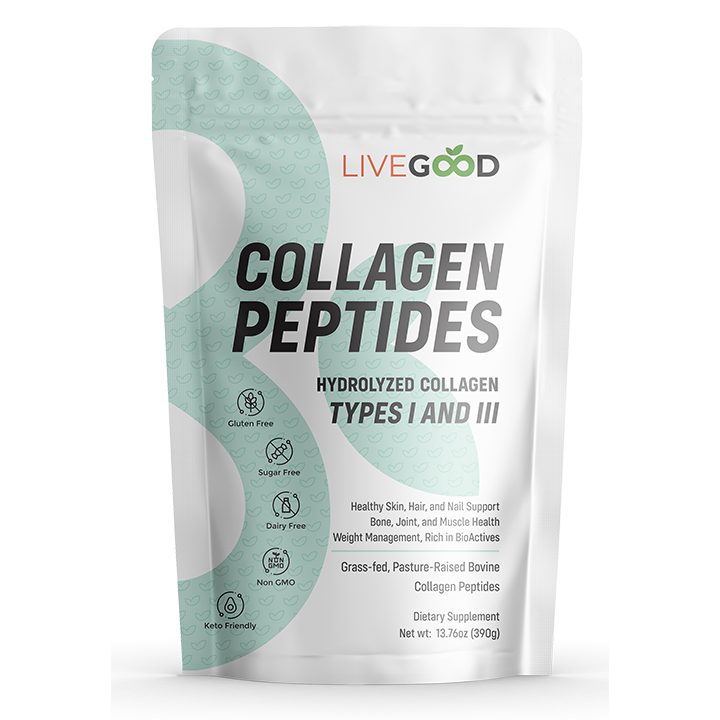
For a simple daily option, LiveGood Collagen Peptides provides hydrolyzed collagen types I and III and is the first and only collagen product that also includes Velositol, Polynol and ApresFlex. The formula supports skin elasticity, hair and nail growth, joint function, muscle and bone structure, and healthy weight management. Follow the label and consider making it part of your pre-workout routine. Members pay $29.95 versus $49.95 retail, making consistent wellness more accessible.
How Long Before You Notice Anything
Collagen is not a pre-workout stimulant. You should not expect an immediate rush, extra energy, or an obvious change after one serving. The one-hour window is about aligning circulating amino acids with exercise, not creating a feeling you can detect during the workout.
Connective tissue changes slowly. Studies evaluating collagen alongside exercise often run for several weeks or months. Trials examining skin elasticity, joint comfort, body composition, or training outcomes also use varied timelines, commonly around 8 to 24 weeks. Results are mixed, and not everyone notices a meaningful difference.
Give your routine enough time before judging it. Eight to twelve weeks is a reasonable initial period for tracking gradual changes, provided the product label supports daily use. For exercise-related goals, keep your training program relatively consistent so you are not comparing completely different workloads.
Use simple measures. Record how a repeated exercise feels, whether you complete planned sessions comfortably, and whether your routine is easy to maintain. For skin, hair, or nails, monthly photos under similar lighting may be more useful than checking every day. These observations cannot prove that collagen caused a change, but they can help you evaluate your routine realistically.
Do not continue training through persistent pain while waiting for a supplement to work. Pain, swelling, sudden weakness, or loss of movement deserves evaluation by a qualified healthcare professional. Collagen supports normal body structures, but it does not diagnose or treat an injury or joint condition.
Frequently Asked Questions
Should you take collagen before or after a workout?
Taking collagen about one hour before a workout is the more research-informed choice when your goal is connective tissue support. Small studies have paired collagen or gelatine, vitamin C, and loading exercise during this window. Post-workout collagen is still acceptable if it fits your routine better, but use complete protein for muscle recovery.
Is collagen good post workout?
Collagen can be taken post workout, but it is not an ideal replacement for a complete recovery protein. It provides amino acids associated with connective tissue, yet it is low in leucine and tryptophan. Pair it with a complete protein source, or take collagen before training and eat a protein-rich meal afterward.
Does collagen need vitamin C?
Your body needs vitamin C to produce and stabilize collagen, but collagen powder does not always need to be swallowed with a vitamin C supplement. Adequate vitamin C from your overall diet may be enough. The key timing study used vitamin C-enriched gelatine, so including a vitamin C-rich food before exercise is a reasonable approach.
Does collagen build muscle?
Collagen is not an effective stand-alone muscle-building protein because it lacks a balanced supply of essential amino acids. In particular, it is low in leucine and contains little to no tryptophan. For muscle growth, prioritize progressive resistance training, enough total protein, and complete sources such as whey, dairy, eggs, soy, or balanced plant protein.
How much collagen per day?
Collagen research commonly uses about 2.5 to 15 grams per day, depending on the form and goal. One small exercise study tested 5 and 15 grams of gelatine with vitamin C before loading. These amounts provide research context, not personal dosing advice. Follow your product's label and ask your doctor if you have medical concerns.