
Does Creatine Build Real Strength or Just Water?
 Written by Nauder Khazan
Ask AI about this article and Creatine + HMB





Creatine can do both, but on different timelines. The weight you gain in the first several days is largely water pulled into muscle, while meaningful strength gains develop over weeks as creatine helps you train harder. Separating those two effects makes the results much easier to understand.
Key Takeaways
- Early weight is mostly water: Creatine draws water into muscle cells, so the scale may rise before you build new muscle tissue.
- The water is not fat: This fluid is primarily stored inside muscle, rather than automatically making your whole body look puffy.
- Strength develops through training: Better support for short, intense efforts can help you complete more quality work and adapt over time.
- Lean mass needs context: A study's increase in lean mass may include water as well as newly developed muscle tissue.
- Responses differ: Some people notice clear benefits, while others respond modestly or not at all.
The First Week Is Mostly Water
Creatine monohydrate increases the amount of creatine stored in your muscles. As those stores rise, water moves into the muscle cells with them. That is why your body weight can increase within a few days, especially if you use a loading protocol that fills muscle creatine stores quickly.
This early change is mostly intramuscular water, meaning water held inside muscle. It is not the same as gaining body fat. It also does not necessarily mean you will look soft or swollen. Some people feel that their muscles look slightly fuller. Others notice only a higher number on the scale, and some see very little change at all.

Early creatine weight gain mainly reflects water stored inside muscle rather than added body fat.
The amount varies with body size, diet, starting creatine stores, hydration, and whether you load. A dramatic jump, such as 10 pounds in a few days, is not a typical result to assume is entirely from creatine. Sodium intake, carbohydrate intake, menstrual cycle changes, digestion, and measurement conditions can all move the scale. Unexpected or persistent swelling deserves medical guidance.
Early body composition readings can also be misleading. Many scales and scanning devices count water-containing tissue as lean mass. If a scan says you gained lean mass after one week, that does not mean you built that much new muscle protein. The honest interpretation is that some of the increase is likely water. Real muscle development takes repeated training sessions, adequate nutrition, and time.
Where Real Strength Gains Come From
Creatine is stored partly as phosphocreatine, a high-energy reserve inside muscle. During a hard set, phosphocreatine helps rebuild adenosine triphosphate, or ATP. ATP is the immediate energy your muscle cells use to contract. Your available supply is limited, especially during brief, intense efforts such as heavy lifting, jumping, or sprinting.
Creatine does not simply add pounds to the bar the moment water enters your muscles. Its more useful role is helping replenish ATP between demanding efforts. That may allow you to preserve power across repeated sets, complete an extra repetition, or maintain better training quality before fatigue takes over.

Creatine supports rapid energy recycling during demanding sets, which may help you maintain training quality.
One extra repetition sounds small, but strength adaptation is built from small improvements repeated over time. If creatine helps you perform slightly more productive work each week, your muscles receive a stronger reason to adapt. Your nervous system also becomes more skilled at recruiting muscle fibers, which means activating the right muscle tissue for a movement. Together, those adaptations can produce real strength gains.
This is why creatine works best alongside progressive resistance training. Progressive training means gradually increasing the challenge by adding weight, repetitions, sets, or better technique. Creatine cannot replace that stimulus. It also cannot replace sufficient food, protein, sleep, or recovery.
The effect is not identical for everyone. People with lower starting muscle creatine stores, including some vegetarians and vegans, may respond more noticeably. Other people begin with relatively full stores and see smaller changes. A minority appear to be low responders or non-responders, so a subtle result does not always mean the routine was followed incorrectly.
What the Trials Measured
Controlled trials do not judge creatine by appearance alone. Researchers usually compare a creatine group with a placebo group while both complete similar training. They may test a one-repetition maximum, the heaviest weight lifted once with proper form, or count how much total work participants perform across several sets.
A frequently cited review indexed on PubMed found that, across the included studies, strength gains were greater with creatine than with placebo during resistance training. Those numbers were group averages, not a promise for each person. The studies also differed in exercises, participants, training plans, doses, and duration.
| Measure | What it can tell you | What it cannot prove alone |
|---|---|---|
| Scale weight | Total body weight changed | Whether the change was water, fat, or muscle |
| Lean mass | Non-fat mass increased | How much was new muscle protein rather than water |
| One-rep maximum | Maximum tested strength improved | Why it improved or whether every exercise improved |
| Training volume | More total repetitions or weight were completed | That visible muscle growth has already occurred |

Strength tests and training logs reveal more about performance than a scale reading alone.
The distinction between lean mass and actual muscle tissue matters. Creatine-related water inside muscle counts as lean mass on many measurements. Longer trials that combine creatine with resistance training are more useful because they give genuine tissue adaptation time to occur. Even then, no single measurement perfectly separates water from muscle.
The broader evidence supports creatine monohydrate for improving high-intensity exercise performance and strength training outcomes in many adults. It does not show that every user becomes stronger, nor that creatine builds substantial muscle without training. Creatine monohydrate remains the most studied form and the honest baseline when comparing creatine products. More expensive forms have not consistently shown better results.
Does the Muscle Stay If You Stop?
When you stop taking creatine, elevated muscle creatine stores gradually return toward your usual level. This generally happens over several weeks rather than overnight. As the stored creatine declines, some of the extra water held inside muscle also leaves. Your scale weight may fall, and your muscles may look slightly less full.
That water loss is not the same as suddenly losing all the muscle you developed while training. New muscle tissue built through months of progressive resistance training can remain if you continue providing a training stimulus and enough nutrition. Creatine helped support the work, but your body made the adaptation.

Continuing resistance training helps maintain muscle developed while using creatine.
You may notice a small change in repeated high-intensity performance after stopping. For example, the final repetition of a difficult set may feel harder once your muscle creatine stores return to baseline. That does not mean all your strength disappears. Technique, nervous system adaptations, and developed muscle tissue do not vanish simply because you stopped supplementing.
What happens next depends more on your routine than on creatine withdrawal. If you keep lifting consistently, eating adequately, and recovering well, much of your training progress can remain. If you also stop training, strength and muscle can decline over time through detraining, whether or not you used creatine.
There is no automatic conversion of creatine-related water into fat. If the scale drops after stopping, it is likely reflecting reduced muscle water. If it rises later, look at the full picture, including food intake, activity, hydration, and normal daily variation.
Loading Versus Starting Low
A loading phase fills muscle creatine stores faster. Research protocols commonly use about 20 grams per day, split into several smaller servings, for five to seven days. A slower approach commonly uses 3 to 5 grams per day, which may take roughly three to four weeks to produce similar muscle saturation. These are research contexts, not personalized dosing instructions, so follow your product label.
The main difference is speed, not the final destination. Loading may produce earlier scale weight and possibly earlier workout effects because muscle stores rise quickly. It can also be less convenient and may cause digestive discomfort in some people. Starting with a standard daily serving takes longer, but it is simple and often easier to tolerate.

Loading fills muscle creatine stores faster, while a standard daily serving reaches a similar level more gradually.
Timing matters less than consistency. Creatine does not work like a stimulant that must be taken immediately before exercise. Its benefit depends on maintaining higher muscle stores over time. Taking it at a time you can remember is generally more practical than chasing a narrow workout window. Mixing it with a meal or drink may also make a daily habit easier.
Give your routine enough time before judging it. Track performance across several comparable workouts, not one unusually good or bad session. Look at repeated sets, total repetitions, lifting technique, and gradual load increases. The scale can help you see the early water change, but your training log is better for evaluating real strength.
Creatine is considered well studied for many healthy adults, but individual needs differ. Talk to your doctor before using it if you take prescription medications, are pregnant or breastfeeding, have kidney or liver concerns, or live with an existing medical condition. Stop and seek guidance if you experience an unexpected reaction.
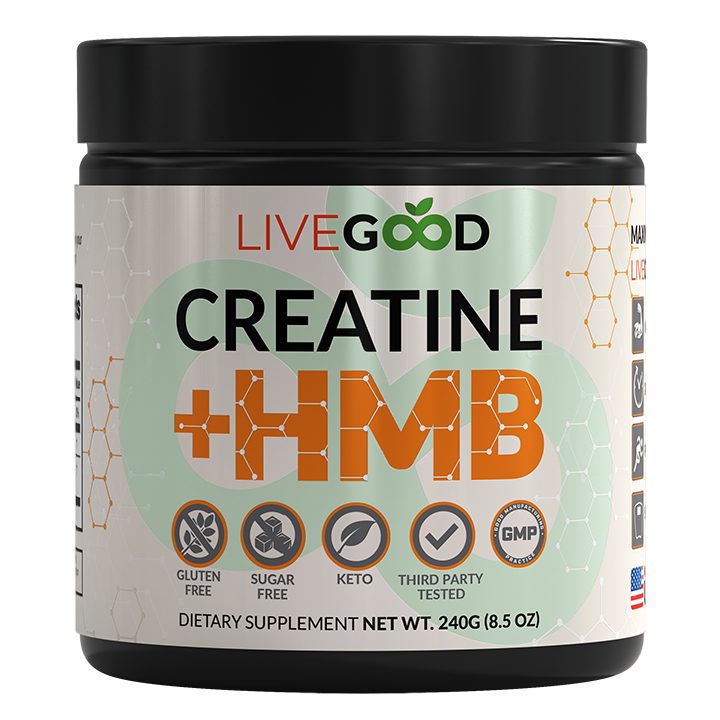
LiveGood Creatine + HMB provides 5 grams of creatine monohydrate plus 3 grams of HMB per serving, with no junk fillers, flavors, or additives. It is formulated to support muscles, brain, and heart while helping maintain muscle and cognitive health with age. Follow the label and pair it with consistent training. It is $19.95 for members versus $34.95 retail, supporting LiveGood's mission to "Provide the highest quality supplements in the world, at the lowest prices possible."
Frequently Asked Questions
Consistent training over several weeks helps separate real strength progress from early water weight.
Does creatine increase real strength?
Yes, creatine can support genuine strength gains when you combine it with progressive resistance training. It helps replenish ATP, the immediate energy used during hard muscular efforts. That can improve training quality across repeated sets, creating more opportunity for your muscles and nervous system to adapt. Results vary, and some people notice only a modest difference.
Is creatine weight gain just water?
The earliest weight increase from creatine is largely water drawn into muscle cells, but later gains may include actual muscle tissue if you train consistently. This water is not body fat, and it may make muscles look fuller rather than causing general puffiness. Because lean-mass measurements include water, very rapid changes should not be labeled as new muscle.
What happens if you stop taking creatine?
Your elevated creatine stores and some associated muscle water gradually decline after you stop, so the scale may move down. Muscle developed through training does not automatically disappear. Continuing to lift, eat adequately, and recover supports retention of that tissue, although you may lose a small performance advantage during repeated high-intensity efforts.
Do you need a loading phase?
No, loading is optional. It raises muscle creatine stores more quickly, while a standard daily serving reaches a similar point more gradually. Research often compares roughly one week of loading with several weeks of lower daily intake. Follow the product label, and choose the approach that fits your routine and digestive comfort.
How long until creatine works?
Muscle water and scale weight can change within the first week, especially with loading, but measurable training benefits usually need more time. Without loading, muscle stores may take about three to four weeks to rise substantially. Real strength and muscle changes develop across repeated workouts, so review your training log over several weeks rather than judging one session.