
Greens Powder vs Fruits and Vegetables: What You Actually Get
 Written by Nauder Khazan
Ask AI about this article and Organic Super Greens





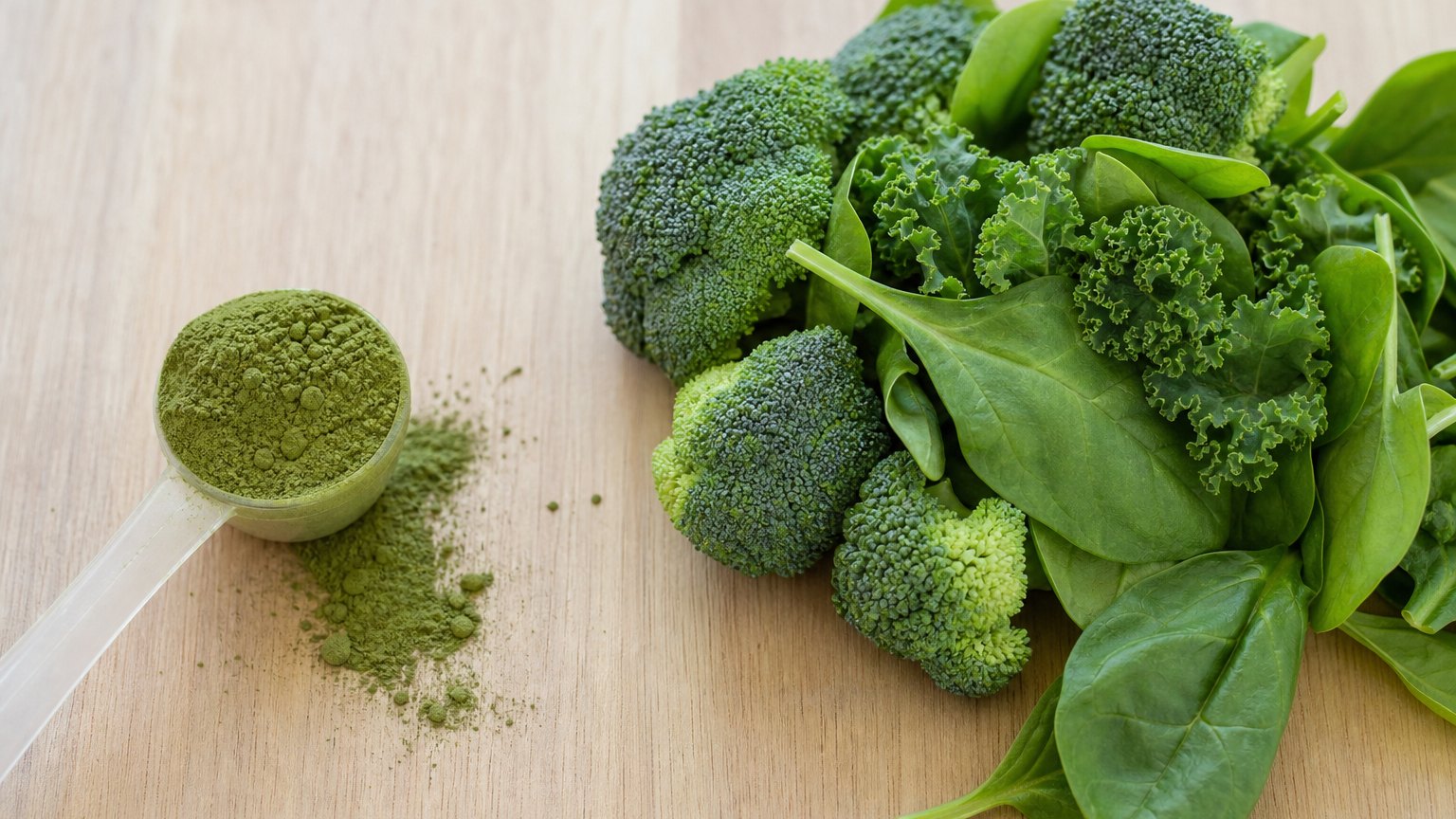
Whole fruits and vegetables are nutritionally more complete than greens powder. They provide substantially more fibre, water, volume and fullness, while powder mainly offers convenience and shelf life. Here is what processing changes, what remains and where a powder can realistically fit.
Key Takeaways
- Whole produce comes first: It provides fibre, water, volume and physical structure that a scoop usually cannot match.
- Fibre is the clearest gap: Many greens powders contain only a small amount, so always check the Nutrition Facts panel.
- Some nutrients survive: Minerals and certain plant compounds remain, but processing and storage can reduce sensitive vitamins.
- Serving claims need caution: There is no standard formula for converting a scoop into servings of vegetables.
- Convenience is the real advantage: Powder stores well and takes seconds to mix when fresh produce is unavailable.
What Drying and Milling Change
Greens powders usually begin with vegetables, grasses, algae, herbs or fruit. Manufacturers remove most of the water and mill the dried material into a fine powder. Some products use freeze-drying, while others use warm air or other drying methods.
Removing water makes plant material lighter, smaller and more shelf-stable. It also concentrates whatever remains into less space. That is why a scoop can contain ingredients from several plants without having the size of a salad. Concentration, however, does not mean the powder contains every feature of the original foods.
Grinding breaks the plant's physical structure into tiny particles. Chewing does this too, but powder has already been processed much further before it reaches your glass. Depending on how the product is made, fibrous parts may be retained, reduced or removed. Powders made from juice extracts can be especially low in fibre because the pulp was separated earlier.
Heat, light and oxygen can also affect nutrients. Vitamin C and some B vitamins are relatively sensitive, so their amounts may decline during processing and storage. Minerals such as calcium, iron and potassium are more stable because drying does not destroy them.
The ingredient list tells you what went into a product, not how much of each ingredient survived or how much is present. A long list of plants is not the same as a plate containing meaningful portions of those foods. The Nutrition Facts and Supplement Facts panels are more useful than pictures of vegetables on the package.
Fibre Is the Biggest Difference
Fibre is the largest and most consistent gap between greens powder and whole produce. It is the part of plant food that your digestive enzymes do not fully break down. Different types of fibre add bulk, hold water or provide food for microbes that normally live in your digestive tract.
Whole fruits and vegetables deliver fibre as part of their natural structure. A medium apple with its skin provides roughly 4 grams. A cup of raspberries has about 8 grams, while a cup of cooked broccoli provides around 5 grams. Eating several different plants across the day can therefore make a meaningful contribution to your daily intake.
Many greens powders provide only 1 or 2 grams per scoop, and some provide less. A powder can contain more, but you have to verify that on its label. Do not assume that spinach, kale or broccoli in the ingredient list guarantees a high-fibre serving.
This matters because a scoop cannot recreate the fibre supplied by several actual servings of produce. It also means a greens powder does not replace fruits and vegetables and cannot count toward five a day. You still need whole plant foods in meals and snacks.
Be sceptical of claims that one scoop equals several servings of vegetables. These servings-equivalent claims are not standardised. One company may base its number on raw ingredient weight, another on selected nutrients, and another may not explain the calculation. Compare labelled grams of fibre and listed nutrient amounts instead of relying on an undefined serving claim.
Volume, Water and Fullness
Fresh fruits and vegetables contain a great deal of water. Lettuce, cucumbers, tomatoes, berries, oranges and many other types are mostly water by weight. That water gives food size and weight without requiring a concentrated amount of dry material.
Volume matters when you eat. A bowl of vegetables takes up room on your plate and in your stomach. You also have to bite and chew it. These physical features slow the eating process and can help a meal feel more substantial. Whole fruit has a similar advantage over a small drink because it combines water, fibre and chewing.
A scoop of powder mixed into water gives you fluid, but it does not rebuild the original pieces of fruit and vegetables. The drink may be useful, yet it is unlikely to provide the same fullness as an apple, carrots with hummus or a plate of roasted vegetables. It should not be treated as a meal by itself.
A smoothie sits somewhere in the middle. Blending whole fruit and vegetables keeps most of their fibre, although it breaks their structure into smaller particles. Adding greens powder to that smoothie does not remove the fibre from the whole ingredients. By contrast, juice generally loses much of the pulp and fibre during extraction.
If fullness is your goal, use actual produce as the foundation. Frozen berries, bananas, leafy greens, beans and cooked vegetables can all add physical substance. Think of powder as an optional addition, not the part responsible for replacing food volume.
What Survives Processing
Drying does not turn plants into empty material. A greens powder may retain minerals, pigments and a range of naturally occurring plant compounds. The exact result depends on the ingredients, processing method, storage conditions and time since production.
Minerals are generally stable. They do not disappear because water is removed, although the amount in one scoop may still be modest. Carotenoids, the pigments behind many yellow, orange and dark green colors, can also remain. Various polyphenols may survive as well. Polyphenols are plant compounds found in foods such as berries, herbs and leafy vegetables.
Sensitive vitamins are less predictable. Vitamin C, folate and certain other B vitamins can decline when exposed to heat, oxygen or light. Freeze-drying may preserve some compounds better than higher-temperature methods, but it does not guarantee that every nutrient remains at its original level. Storage after production matters too.
Some formulas add vitamins or minerals after the plant ingredients are processed. That can raise the labelled amounts, but those added nutrients should not be confused with preserved whole-food structure. Read the label to see which nutrients are actually declared and how much one serving supplies.
There is also more to produce than a list of isolated nutrients. Different plants contain different fibres, textures and compounds in varying combinations. That is one reason variety still matters. A powder may contribute selected nutrients, but it cannot demonstrate that it recreates the full food it came from. Honest comparison starts with the measured label, not the number of ingredients printed across the front.
Cost Per Serving
Cost depends on what you are comparing. A scoop of powder may appear less expensive than buying a large selection of fresh greens, especially if produce often spoils in your refrigerator. It may also be more expensive than basic vegetables such as carrots, cabbage, potatoes or frozen broccoli.
Start by dividing the package price by its number of labelled servings. That gives you the powder's cost per scoop. Then look beyond the scoop count. Check how much fibre it provides and which vitamins or minerals are listed in measurable amounts. A low serving price is less meaningful if you expected the product to replace several servings of food and it does not.
For produce, calculate cost per portion you will realistically eat. Frozen vegetables and fruit are often useful benchmarks because they keep longer and can be used a little at a time. Canned vegetables and fruit can also be practical, although you may want to compare sodium or added sugar on the label. Seasonal produce and sturdy options such as apples, oranges, carrots and cabbage can reduce waste.
Powder has two financial advantages that are easy to overlook. It lasts longer than delicate greens, and there is usually little preparation waste. Those benefits are real, especially if you travel or have an unpredictable schedule. They are convenience savings, not proof of nutritional equivalence.
Compare products according to the job you need done. If you need fibre, fullness or a side dish, whole produce usually offers better value. If you need something shelf-stable that mixes in seconds, a powder may justify its cost even though it does a narrower job.
Where a Powder Genuinely Helps
A greens powder is most useful when the alternative is getting very little plant variety at all. It can sit in a desk drawer, travel bag or kitchen cupboard without wilting. You can mix it quickly on a morning when washing and chopping vegetables is not realistic.
It may also help make an existing routine easier. You could stir a scoop into water or add it to a smoothie that already contains whole fruit, oats, yogurt or another substantial base. The whole ingredients provide the food volume and fibre. The powder remains a convenient supplement to that meal.
Set realistic expectations. A powder cannot repair an otherwise unbalanced diet, and taking more than the label directs is not a shortcut. Use the serving directions on the package. Check the ingredient list for allergens, herbs, added vitamins and sweeteners, particularly if you already use other supplements.
If you take prescription medication, talk to your doctor before starting a greens powder. Some formulas contain vitamin K or herbs that may interact with medicines. You should also talk to your doctor if you are pregnant or breastfeeding, have kidney or liver conditions, or live with another existing medical condition.
For everyday planning, keep easy produce available alongside the powder. Frozen vegetables, prewashed greens, fruit that travels well and lower-sodium canned options all reduce preparation time. This is consistency over quick fixes. Use powder for the days when convenience matters, but keep whole fruits and vegetables as the main target.
LiveGood Organic Super Greens is a USDA certified organic greens powder designed to help fill nutrient gaps your diet is not providing, as "a safety net for your health." Mix one delicious scoop a day into water or a smoothie, while continuing to eat whole produce. It costs $19.95 for members versus $34.95 retail, reflecting LiveGood's mission to "Provide the highest quality supplements in the world, at the lowest prices possible."
Frequently Asked Questions
Is greens powder as good as vegetables?
No, greens powder is not as nutritionally complete as whole vegetables. Vegetables supply more fibre, water, food volume and physical structure, all of which are reduced or missing in most powders. A powder may contribute certain labelled nutrients and is easier to store, but its strongest advantage is convenience rather than equivalence to a plate of vegetables.
Do greens powders have fibre?
Some greens powders contain fibre, but the amount is often small. Many provide around 1 or 2 grams per scoop, while servings of whole fruits, beans and vegetables can provide considerably more. Check the Nutrition Facts panel rather than assuming a plant-based ingredient list means high fibre. Juice-based powders may contain particularly little because the pulp has been removed.
Can greens powder replace fruits and vegetables?
No, greens powder cannot replace fruits and vegetables or count toward five a day. It lacks the usual combination of fibre, water, volume and varied food structure found in whole produce. Use it as an optional supplement on busy days, while continuing to build meals and snacks around actual fruits, vegetables and other fibre-rich plant foods.
How many servings does a scoop equal?
A scoop does not have a reliable, standard number of produce servings. Servings-equivalent marketing claims are not standardised, and brands may calculate them using different measures such as raw ingredient weight or selected nutrients. Look at the scoop's fibre and declared nutrient amounts instead. Those figures offer a more useful comparison than an unexplained claim involving several servings of vegetables.
When is a greens powder worth using?
A greens powder is worth considering when convenience or shelf life is stopping you from including any plant-based variety. It can be useful during travel, rushed mornings or periods when fresh food access is limited. It makes the most sense as a backup or smoothie addition, not as permission to stop buying and eating whole fruits and vegetables.