
Methylene Blue: What the Research Actually Shows
 Written by Ben Glinsky
Ask AI about this article and Methylene Blue Nootropic Dissolving Strips






Methylene blue has one clear, FDA-approved benefit: it treats methemoglobinemia, a serious blood disorder, under medical supervision. Claims about energy, focus, memory, skin health, or longevity come mainly from laboratory and animal research, not strong human evidence. Here is what it does, what remains uncertain, and why its safety warnings deserve your attention.
Key Takeaways
- One use is firmly established: Methylene blue is an FDA-approved prescription treatment for acquired methemoglobinemia.
- Wellness benefits remain unproven: Research on cognition, energy, skin, and longevity is mostly early laboratory or animal work.
- Medication interactions can be dangerous: Combining it with SSRIs, SNRIs, MAOIs, or other serotonergic drugs can cause life-threatening serotonin syndrome.
- G6PD deficiency creates a serious risk: Methylene blue can trigger haemolysis, meaning the rapid destruction of red blood cells.
- Self-dosing is not advised: Therapeutic doses are prescription medicine, and products sold online vary in quality and concentration.
What Methylene Blue Actually Is
Methylene blue is a synthetic dye and medication first developed in the 1800s. It has long been used to stain cells and tissues so they are easier to see under a microscope. In medicine, clinicians have also used it as a visual marker during certain procedures and as a drug with specific effects on blood chemistry.
The compound can accept and donate electrons. In simple terms, it can take part in chemical reactions that move electrical charge between molecules. That feature helps explain its approved medical use and why researchers are studying it in cells and animals.
Methylene blue is also described as a redox compound. "Redox" refers to reactions involving the transfer of electrons. Depending on the dose, environment, and surrounding molecules, the compound may behave differently. That is one reason a promising result in a laboratory dish cannot automatically be turned into a consumer health benefit.
Researchers have examined whether methylene blue affects mitochondria, the structures inside cells that help convert nutrients into usable energy. These experiments have generated interest, but they do not establish that taking methylene blue improves human energy, focus, memory, mood, or longevity.

Methylene blue is both a laboratory dye and a medically active compound, but those roles do not establish consumer wellness benefits.
Purity matters as well. Pharmaceutical methylene blue is manufactured for medical use. Industrial, laboratory, textile, and aquarium dyes are not made for human consumption and may contain contaminants. A blue liquid sold online is not automatically equivalent to a prescription drug or a carefully manufactured consumer product.
What It Is Approved to Treat
Methylene blue is FDA approved to treat acquired methemoglobinemia. This uncommon condition occurs when too much hemoglobin is converted into methemoglobin, a form that cannot carry oxygen effectively. Hemoglobin is the protein in red blood cells that normally transports oxygen from your lungs to the rest of your body.
Methemoglobinemia can cause headache, weakness, shortness of breath, confusion, rapid heart rate, and blue or gray skin. Severe cases can damage organs and become life threatening. Certain medications, chemicals, or toxins may trigger the acquired form.
In a hospital, methylene blue is given intravenously, meaning through a vein. It helps convert methemoglobin back into working hemoglobin so the blood can carry oxygen more normally. Clinicians monitor the patient, confirm the diagnosis, review contraindications, and calculate a medical dose. This is very different from experimenting with an oral product at home.

In hospitals, prescription methylene blue is used under medical supervision to treat acquired methemoglobinemia.
Doctors sometimes use methylene blue off label. An off-label use is one that has not received FDA approval for that specific purpose. It may be considered in specialized settings such as surgery, diagnostic procedures, or selected treatment complications. Off-label use does not mean casual or risk-free use.
A clinical overview from MD Anderson Cancer Center discusses both established medical uses and areas still being researched. Its central caution is useful: many popular claims are not proven, and treatment should involve a clinician familiar with methylene blue. At therapeutic doses, this is a prescription medicine. Self-dosing is not advised.
What the Wellness Claims Rest On
Online benefit lists often say methylene blue improves energy, focus, memory, mood, skin, or lifespan. Those statements go well beyond what human research has established. The excitement comes largely from experiments involving isolated cells, tissue samples, or animals.
Some laboratory studies examine how methylene blue participates in electron transfer inside mitochondria. Other experiments look at oxidative stress, which is an imbalance between unstable molecules and the body's ability to manage them. Researchers have also explored brain proteins, cellular aging, microbes, and light-activated applications. These findings can identify questions worth studying, but they cannot show how a consumer will feel or function.
A few small human studies have explored neurological or cognitive questions. Their limited size, specialized populations, varying doses, and short follow-up make broad conclusions difficult. Research involving a prescription preparation, a related compound, or carefully supervised participants also does not prove that an over-the-counter strip or liquid produces the same result.

Early cell and animal findings can guide future research, but they cannot prove improvements in human cognition or longevity.
The same caution applies to claims about Alzheimer's disease, depression, cancer, skin aging, and pain. Methylene blue is not approved as a treatment for these conditions. Specialized research, including light-activated laboratory techniques, should not be presented as proof that swallowing it prevents or treats disease.
Methylene blue can affect microbes under certain laboratory conditions, especially when paired with light. That does not tell us whether oral use kills harmful or beneficial gut bacteria in people. There is no solid clinical evidence showing that consumer use improves the gut microbiome or selectively removes "bad" bacteria.
Harvard Health's review reaches a similarly cautious conclusion. Interesting biological mechanisms are not the same as demonstrated wellness benefits. Honest supplement education needs to explain that gap rather than turn early research into a promise.
The Safety Issues That Matter Most
The most urgent interaction involves serotonin, a chemical messenger used by the brain and nervous system. Methylene blue can inhibit monoamine oxidase A, an enzyme that helps break down serotonin. Combining it with medicines that raise serotonin may allow dangerous amounts to build up.
This can cause serotonin syndrome. The risk applies to SSRIs, SNRIs, MAOIs, and other serotonergic drugs. SSRIs and SNRIs are common antidepressant classes. Other medicines and supplements, including some migraine drugs, pain medicines, cough products, and mood-related products, may also affect serotonin.
Symptoms can include agitation, confusion, heavy sweating, diarrhea, tremor, muscle stiffness, fever, a fast heartbeat, or rapidly changing blood pressure. Severe serotonin syndrome can cause seizures, organ damage, unconsciousness, and death. It is a medical emergency. If symptoms appear after combining serotonergic substances, seek emergency help rather than waiting for them to pass.
Medication interactions, G6PD deficiency, and pregnancy are major safety concerns that require clear screening.
Another major concern is G6PD deficiency. G6PD is an enzyme that helps protect red blood cells from chemical stress. In someone with this inherited deficiency, methylene blue can cause haemolysis, also called hemolysis, in which red blood cells rupture faster than the body can replace them. This may lead to severe anemia and reduced oxygen delivery.
Other reported effects include nausea, stomach discomfort, headache, dizziness, sweating, and blue or green discoloration of urine, stool, saliva, or skin. Methylene blue can also interfere with pulse oximeters and certain laboratory tests. At excessive doses, it may paradoxically worsen methemoglobinemia rather than correct it. These specific risks are why a label, online calculator, or social media protocol cannot replace medical screening.
Who Should Avoid It Entirely
Do not use methylene blue during pregnancy. The drug can pose fetal risks, and pregnancy is not a setting for consumer experimentation. Breastfeeding also requires avoidance unless a qualified clinician gives specific medical direction, since exposure and safety for the infant must be considered.
People with G6PD deficiency should not take it because of the risk of haemolysis. If you do not know your G6PD status, your ancestry or lack of previous symptoms cannot rule the deficiency out. A clinician can decide whether testing is appropriate.
Anyone taking an SSRI, SNRI, MAOI, or another serotonergic drug should avoid methylene blue unless the prescribing physician and treating medical team have reviewed the combination. Do not stop an antidepressant or other prescription medicine to make room for methylene blue. Abruptly stopping medication can create separate and serious problems.
You should also avoid self-use if you have kidney or liver disease, a blood disorder, a significant medical condition, or a previous reaction to the compound. Your kidneys and liver help process and clear substances from the body, so impaired function may change exposure and risk. Children and older adults with multiple prescriptions need particularly careful medical review.
Consumer products add another layer of uncertainty. Concentration, purity, instructions, and testing may differ across sellers. Never swallow aquarium, textile, microscopy, or industrial-grade methylene blue. Do not estimate a dose by counting drops or copying an online protocol. Therapeutic methylene blue is prescription medicine, and no well-established daily consumer dose exists for the wellness outcomes promoted online.
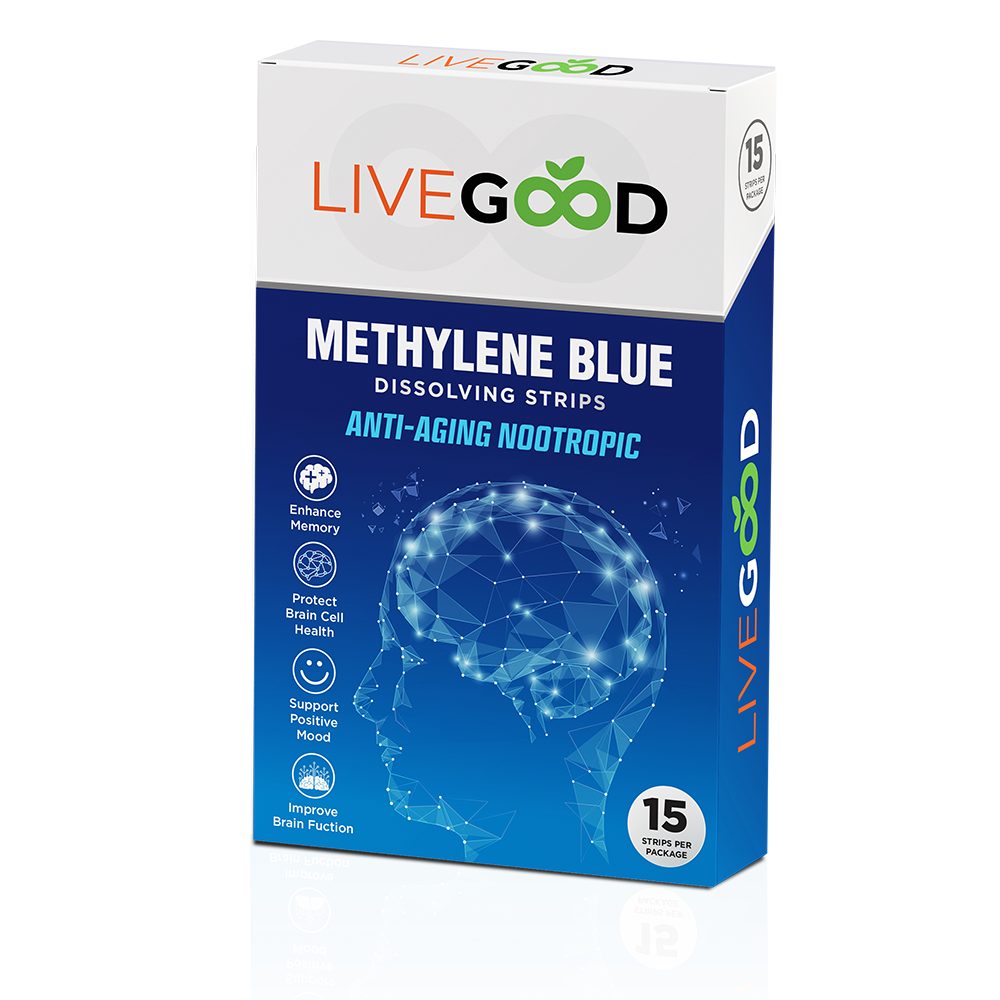
Put a doctor conversation first before considering Methylene Blue Nootropic Dissolving Strips. The box contains 15 nootropic dissolving strips, with label directions to use one every other day for a 30-day supply. It costs $14.95 for members versus $29.95 retail, reflecting LiveGood's membership approach to wellness access. Convenience does not prove a brain benefit or make self-dosing appropriate. Do not use it during pregnancy, while breastfeeding, or with G6PD deficiency. Anyone using an MAOI, SSRI, or other prescription medication needs physician clearance.
Frequently Asked Questions
What is methylene blue used for?
Methylene blue is FDA approved to treat acquired methemoglobinemia, usually through an intravenous dose in a hospital. This condition prevents hemoglobin from carrying oxygen normally. Clinicians also use the drug off label in selected procedures and specialized medical situations. Its use for energy, cognition, skin health, or longevity is not supported by established human evidence.
Is methylene blue safe to take every day?
No daily consumer regimen has been shown to be broadly safe or beneficial. Risk depends on concentration, health history, medications, G6PD status, and product purity. Therapeutic methylene blue is a prescription medicine, and taking it repeatedly without medical screening is not advised. Follow a product label only after a clinician confirms that methylene blue is appropriate for you.
Who should not take methylene blue?
Pregnant people, those who are breastfeeding, and people with G6PD deficiency should avoid consumer methylene blue. It is also unsuitable for anyone using SSRIs, SNRIs, MAOIs, or other serotonergic drugs without explicit physician review. People with kidney disease, liver disease, blood disorders, medication allergies, or other existing conditions should speak with their doctor before considering any form of it.
Does methylene blue interact with antidepressants?
Yes, methylene blue can interact dangerously with antidepressants that increase serotonin, including SSRIs, SNRIs, and MAOIs. The combination may cause serotonin syndrome, which can become life threatening. Warning signs include agitation, confusion, sweating, fever, diarrhea, tremor, rigid muscles, and a rapid heartbeat. Do not stop an antidepressant on your own to take methylene blue.
What are the side effects of methylene blue?
Possible side effects include nausea, stomach discomfort, headache, dizziness, sweating, and blue or green urine, stool, or saliva. More serious risks include serotonin syndrome, haemolysis in people with G6PD deficiency, allergic reactions, and worsened methemoglobinemia at excessive doses. It may also distort pulse oximeter readings and some laboratory results.