
What Does Bioactive Mean on a Vitamin Label?
 Written by Ben Glinsky
Ask AI about this article and Bio-Active Complete Multi-Vitamin For Men






On a vitamin label, "bioactive" usually means the nutrient is already in a form your body can use without first converting it. That can be helpful for some people, but it does not automatically make a supplement more effective for everyone. Here is what the term means, which ingredient names to look for, and where the marketing can get ahead of the evidence.
Key Takeaways
- Bioactive usually means ready to use: The vitamin is supplied in an active or coenzyme-ready form that requires little or no initial conversion.
- Look beyond the front label: The Supplement Facts panel tells you more than words such as "bioactive," "advanced," or "premium."
- Common examples are B vitamins: Methylfolate, methylcobalamin, adenosylcobalamin, and P-5-P are familiar active forms.
- Individual conversion can vary: Genetics, nutrition, medications, age, and health can influence how nutrients are processed.
- The difference is often overstated: Standard forms work well for many people, and an active form does not guarantee better absorption or noticeable results.
What Bioactive Actually Means
The clearest definition is simple: a bioactive vitamin form is one your body can use without first changing it into another chemical form. These are often called active, activated, methylated, or coenzyme forms. A coenzyme is a small molecule that helps an enzyme perform a chemical task in the body.
For example, folic acid must pass through several conversion steps before it becomes a form used in folate-dependent pathways. L-5-methyltetrahydrofolate, usually shortened to 5-MTHF or methylfolate, is already an active folate form. Likewise, methylcobalamin and adenosylcobalamin are active forms of vitamin B12, while cyanocobalamin must be converted. Pyridoxal-5-phosphate, or P-5-P, is the active coenzyme form of vitamin B6.
There is an important catch. "Bioactive" does not have one tightly controlled meaning across every supplement label. In broader nutrition science, a bioactive compound can be any food or supplement component that interacts with biological processes. That broad category includes substances that are not vitamins, such as carotenoids and polyphenols.
On vitamin packaging, however, the word usually points to an active nutrient form. It does not mean the ingredient skips digestion, enters every cell immediately, or produces faster results. Absorption, transport, dose, nutrient status, and the rest of the formula still matter.

Bioactive vitamin forms are already positioned for use in normal metabolic pathways, although digestion and absorption still matter.
The Forms You Will See on Labels
Bioactive language appears most often around B vitamins because several B vitamins have well-known active coenzyme forms. The front of a bottle may say "methylated B vitamins" or "bioactive B complex," but the ingredient list is where you can verify what is actually included.
| Vitamin | Common bioactive label names | Common form requiring conversion |
|---|---|---|
| Folate, B9 | L-5-MTHF, 5-MTHF, methylfolate, calcium L-methylfolate | Folic acid |
| Vitamin B12 | Methylcobalamin, adenosylcobalamin | Cyanocobalamin |
| Vitamin B6 | Pyridoxal-5-phosphate, P-5-P, PLP | Pyridoxine hydrochloride, pyridoxine HCl |
Methylfolate is an active form of folate used in one-carbon metabolism. That is the network of reactions involved in making DNA, processing certain amino acids, and producing new cells. Methylcobalamin and adenosylcobalamin serve different B12-dependent reactions. A formula may contain one or both. P-5-P helps enzymes involved in amino acid metabolism and many other normal processes.
You may also see "active" attached to ingredients outside this short list. Evaluate those claims individually. A mineral cannot be methylated into an active vitamin form, for example. Terms such as magnesium glycinate and zinc citrate describe what the mineral is bound to, not whether it is a bioactive vitamin.
Also check the amount per serving. A recognizable form does not compensate for a poorly designed dose, and more is not automatically better.

The ingredient names in the Supplement Facts panel reveal whether a formula contains active forms of folate, B12, and B6.
Why Conversion Matters for Some People
Conversion is the series of enzyme-driven steps that changes one nutrient form into another. Enzymes are proteins that help chemical reactions happen. Most people perform these steps every day without feeling them or thinking about them.
Even so, conversion efficiency is not identical in everyone. It can be influenced by overall nutrition, genetic differences, medication use, alcohol intake, age, and the health of organs involved in nutrient processing. An active form removes at least one conversion step, which may make it a reasonable formulation choice when convenience and direct usability are priorities.
This does not mean you can diagnose a conversion problem from fatigue, stress, or another vague symptom. Those experiences have many possible causes. It also does not mean active vitamins treat poor conversion or any underlying condition.
MTHFR gene variants often come up in discussions of methylfolate. MTHFR is the name of an enzyme involved in folate metabolism. Common variants can affect enzyme activity, but a consumer genetic result does not tell you by itself which supplement you need. If you have questions about an MTHFR result, folate status, symptoms, or laboratory testing, talk to your doctor rather than self-diagnosing.
The practical benefit may be greatest for someone whose clinician has identified a reason to pay close attention to nutrient form. For everyone else, choosing an active form can still be a preference, but the likely difference is often less dramatic than the label suggests.

Nutrient conversion varies among individuals, but symptoms alone cannot show whether someone has difficulty processing a vitamin.
Where the Difference Is Overstated
Bioactive does not automatically mean superior. It also does not mean a vitamin is absorbed completely, works instantly, or creates a feeling you can notice. A usable chemical form is only one part of what happens after you swallow a supplement.
First, the ingredient still has to be released from the tablet or capsule and absorbed through the digestive tract. It then has to travel through the body, enter the appropriate tissues, and participate in normal metabolism. Food, digestive health, dose, timing, and interactions with other nutrients can affect those steps.
Second, standard vitamin forms are not useless. Many people convert folic acid, cyanocobalamin, and pyridoxine normally. These forms have been used widely and can contribute to adequate nutrient intake. For someone with normal absorption and conversion, changing forms may not produce a meaningful or noticeable difference.
Third, active forms do not create energy like caffeine. B vitamins support normal energy metabolism, which means they help your body process energy from food. Taking extra B vitamins does not necessarily increase energy when your intake and vitamin status are already adequate.
Finally, the word "bioactive" says nothing about the entire product. It does not reveal whether the serving is appropriate, whether other nutrients are included, or whether the formula fits your diet. A balanced formula you take consistently may be more useful than an impressive-sounding formula you do not need or do not tolerate. Honest supplement education means recognizing both possibilities: active forms can be thoughtful choices, but they are not guaranteed upgrades for every person.
Reading a Label for Forms
Start with the Supplement Facts panel, not the large claims on the front. Find the vitamin name, then read the form shown in parentheses. "Vitamin B12 (as methylcobalamin)" tells you much more than a general phrase such as "high-potency bioactive blend."
Use this quick label check:
- Identify the exact form. For folate, look for 5-MTHF or methylfolate. For B12, look for methylcobalamin or adenosylcobalamin. For B6, look for P-5-P or pyridoxal-5-phosphate.
- Check the amount and Daily Value. A high percentage is not automatically necessary or more effective. Some B vitamins commonly appear above 100% Daily Value because they are used in small amounts and formulas vary.
- Review the whole formula. Look for duplicate nutrients across your multivitamin, B complex, fortified foods, and single-nutrient supplements.
- Follow the label directions. Do not increase the serving simply because a nutrient is water-soluble or described as active.
- Consider your routine. A supplement only supports your diet when you can use it consistently. Food may also improve comfort if the label recommends taking the product with a meal.
Talk to your doctor before changing supplements if you take prescription medication, are pregnant or breastfeeding, have kidney or liver conditions, or manage an existing medical condition. This is especially useful when a formula contains high nutrient amounts or when laboratory results are guiding your choice.
Comparing nutrient form, amount, Daily Value, and the complete formula provides a clearer label assessment.
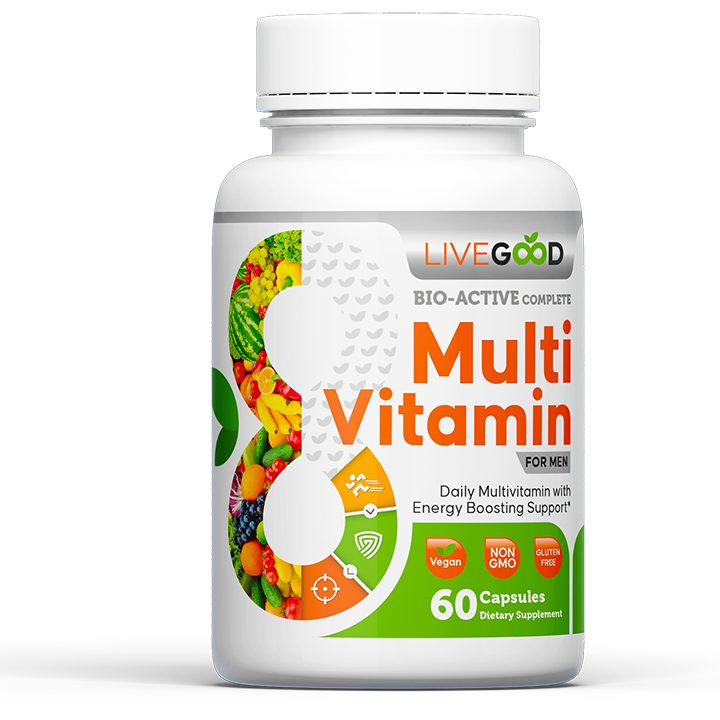
Bio-Active Complete Multi-Vitamin For Men is a daily multivitamin strategically formulated with 24 vitamins and minerals at optimal dosages to help fill common gaps in men's everyday diets. It includes methylcobalamin, an active form of B12, to support normal energy metabolism, so it is best taken in the morning with food as directed. It is $12.95 for members versus $19.95 retail. This reflects LiveGood's mission: Provide the highest quality supplements in the world, at the lowest prices possible.
Frequently Asked Questions
What does bioactive mean in vitamins?
Bioactive means the vitamin is supplied in a form the body can use with little or no initial conversion. Examples include methylfolate for vitamin B9, methylcobalamin or adenosylcobalamin for B12, and P-5-P for B6. The term is used loosely on labels, so confirm the specific ingredient form in the Supplement Facts panel.
Is bioactive better than a regular multivitamin?
A bioactive multivitamin is not automatically better for every person. Active forms remove certain conversion steps, which may matter more for some individuals than others. Many people process standard forms normally and may notice no practical difference. Formula balance, appropriate amounts, diet, tolerability, and consistent use are just as important as the form listed.
What is the difference between folate and folic acid?
Folate is the general name for vitamin B9 forms, while folic acid is a manufactured form commonly used in supplements and fortified foods. Your body must convert folic acid before using it in key folate pathways. Methylfolate, often listed as 5-MTHF, is already an active folate form, although it still requires normal absorption and transport.
What does methylated vitamin mean?
A methylated vitamin contains a chemical group called a methyl group and is usually supplied in a metabolically active form. Methylfolate and methylcobalamin are common examples. "Methylated" does not mean stronger, faster, or better absorbed in every situation. It mainly describes the vitamin's chemical structure and its place in normal metabolic pathways.
Who benefits most from bioactive forms?
People who have discussed nutrient conversion, laboratory results, diet, or supplement selection with a clinician may have the clearest reason to consider bioactive forms. Others may simply prefer them. Individual needs vary, and most people should not assume they have a conversion problem based on symptoms or a genetic report alone. Ask your doctor for personalized guidance.