
What Vitamins Should Men Actually Take?
 Written by Nauder Khazan
Ask AI about this article and Bio-Active Complete Multi-Vitamin For Men






The best vitamins for men to take are the ones that address a real nutritional gap. For many men, vitamin D deserves attention, while magnesium and fibre are common shortfalls even though they are not vitamins. Your diet, sun exposure, age, health history and medications determine what belongs in your routine.
Key Takeaways
- Start with your actual gaps: Your food habits, sun exposure, age and health history matter more than a generic top-five list.
- Watch three common shortfalls: Vitamin D, magnesium and fibre deserve attention in many men's diets.
- Treat vitamin D differently: Sunlight affects your supply, and a blood test can help identify whether you are low.
- Be cautious with iron: Most men should not add supplemental iron unless a doctor identifies a reason.
- Read beyond the front label: Check amounts, forms, serving size and percent Daily Value before choosing a men's formula.
Start With Gaps, Not Products
There is no single daily vitamin plan that every man needs. A man who eats fish, dairy, vegetables, beans and whole grains has a different starting point from someone who skips breakfast, rarely cooks or follows a restricted diet. Sun exposure, age and certain health conditions change the picture again.
Begin with a simple seven-day food check. You do not need to count every calorie. Write down how often you eat vegetables, fruit, beans, whole grains, nuts, seeds, dairy or fortified alternatives, eggs and seafood. Repeatedly missing an entire food group is more useful information than one unusually healthy or unhealthy day.
Next, consider your circumstances. Men who eat a vegan diet need a reliable vitamin B12 source. Men with little sun exposure may need to investigate vitamin D. Absorption can change with age, so men over 50 may need to pay closer attention to B12 and vitamin D. However, turning 40, 50 or 70 does not automatically create the same supplement needs in everyone.

A short food review can reveal more about a man's likely nutrient gaps than a generic supplement list.
Symptoms such as fatigue are not specific enough to diagnose a nutrient deficiency. Sleep, stress, activity, medications and health conditions can produce similar changes. When a deficiency is possible, ask your doctor whether testing makes sense instead of guessing with a high-dose supplement. A University of Utah nutrition discussion makes the same practical point: supplement decisions are more nuanced than blanket recommendations.
The Shortfalls That Are Actually Common
Vitamin D, magnesium and fibre are sensible places to begin a men's gap analysis. They are not automatically deficiencies. A shortfall means intake may be below recommendations, while a deficiency is a medical finding based on symptoms, examination or testing.
Vitamin D supports normal calcium absorption, bones, muscles and immune function. Few foods naturally contain much of it. Fatty fish, egg yolks and fortified foods contribute, but sunlight is also a major source. That makes vitamin D intake harder to judge from food alone.
Magnesium is a mineral, not a vitamin. It supports normal muscle and nerve function, energy production and hundreds of chemical reactions in the body. Good sources include pumpkin seeds, almonds, beans, whole grains and leafy greens. Men who eat few plant foods may have low intake even when they consume plenty of calories.

Nuts, seeds, beans, whole grains and leafy vegetables are useful dietary sources of magnesium.
Fibre is neither a vitamin nor a mineral, but it is one of the most commonly overlooked parts of men's nutrition. It supports regular digestion and helps maintain a healthy gut environment. Beans, lentils, berries, vegetables, oats and other whole grains provide fibre along with a wider package of nutrients. A standard multivitamin cannot replace these foods because meaningful fibre servings are too bulky for a small tablet or capsule.

Fibre-rich foods provide nutritional benefits that a standard multivitamin cannot replace.
Other gaps depend more heavily on diet. Vitamin B12 deserves attention for vegan men and some older adults. Calcium may be low when dairy and fortified alternatives are absent. Omega-3 fats may be limited when fish, walnuts, chia and flax rarely appear on the menu. These are reasons to examine your routine, not proof that every man needs another bottle.
Vitamin D and Why It Is Different
Vitamin D is different because your body can make it when skin is exposed to ultraviolet B light from the sun. Food is only part of the equation. Season, latitude, time outdoors, clothing, skin pigmentation and age can all affect how much your body produces.
This explains why two men eating similar diets can have very different vitamin D levels. Someone who works outside in a sunny climate has a different exposure pattern from someone who works indoors through a northern winter. Sunlight is not a precise dosing tool, however, and excessive exposure carries its own risks.
The blood test used to assess vitamin D status is called 25-hydroxyvitamin D, often shortened to 25(OH)D. A doctor can interpret the result alongside your medical history. Testing may be especially useful if you have risk factors, very limited sun exposure or a previously low level. It is better evidence than trying to judge vitamin D status from energy, mood or muscle sensations alone.

Vitamin D needs can vary with season, location, skin pigmentation, age and time spent outdoors.
Vitamin D is fat-soluble, meaning your body can store it. More is not automatically better, and taking large amounts for a long time can be harmful. Follow the product label unless your clinician gives you a different plan based on testing. Talk to your doctor before supplementing if you take prescription medication or have a kidney, liver or existing medical condition.
If you use vitamin D, consistency matters more than chasing an immediate feeling. It supports normal body functions, but it is not a stimulant and may not produce a noticeable day-to-day sensation.
Why Men Usually Should Not Add Iron
Most adult men should not take an iron supplement without a specific reason. Men generally lose less iron than menstruating women, and many obtain enough from meat, seafood, beans, lentils, fortified grains and other foods. That is why men's multivitamins are often made without iron.
Iron is essential for haemoglobin, the protein in red blood cells that carries oxygen. But the body has limited ways to remove excess iron. Unnecessary supplementation can cause digestive discomfort and, over time, may contribute to excessive iron stores. More iron does not create more energy when low iron is not the problem.
Haemochromatosis is a particularly important reason not to supplement casually. This inherited condition causes the body to absorb too much iron. Iron can then accumulate in tissues and damage organs. Some people do not know they have it until blood testing reveals abnormal iron markers or symptoms appear. If haemochromatosis runs in your family, or a test shows high iron, talk to your doctor and do not add iron on your own.

Men should check labels for added iron and supplement it only when a clinician identifies a need.
Low iron can still occur in men, but it calls for medical evaluation. Possible reasons include a restrictive diet, frequent blood donation, reduced absorption or blood loss. Taking iron before finding the cause can obscure the bigger issue. A doctor may use tests such as a complete blood count, ferritin and transferrin saturation to assess red blood cells and stored iron.
If a clinician confirms that you need iron, follow that individualized plan. Otherwise, choose a men's formula without iron and avoid stacking multiple fortified products that provide it.
Reading a Men's Formula
A men's multivitamin should fill modest gaps, not overwhelm you with the highest numbers on the shelf. Start with the Supplement Facts panel. The serving size tells you how many tablets or capsules provide the listed amounts. The percent Daily Value shows how much a serving contributes toward a general daily reference amount.
Do not assume 500 or 1,000 percent Daily Value is better than 100 percent. High amounts may be unnecessary, and several supplements can overlap. Add up nutrients from your multivitamin, single-nutrient products, drink mixes and heavily fortified foods before combining them.
Check these practical details:
- Look for vitamin D if your diet and sun exposure leave a likely gap.
- Check whether the formula contains iron. Most men should avoid added iron unless a clinician recommends it.
- Notice the magnesium amount. Multivitamins often contain less than a full day's need because magnesium takes up considerable space.
- Confirm the serving size and follow the label directions.
- Review vitamin B12 if you eat no animal foods or are an older adult.
You may also see terms such as methylcobalamin, a form of vitamin B12, or methylfolate, a form of folate. These are sometimes called bioactive forms because they are ready for the body to use through fewer conversion steps. That does not guarantee a dramatic difference for every person. Our explanation of what bioactive means in vitamins can help you interpret those label terms without the hype.
The Supplement Facts panel shows serving size, nutrient amounts and percent Daily Value.
Take the formula as its label directs, usually with food if recommended. Morning can be convenient for building a consistent routine. Ask your doctor to review the label if you take prescription medication or have kidney, liver or other medical conditions. Supplements can support a sound diet, but they cannot supply its protein, fibre and full variety of plant compounds.
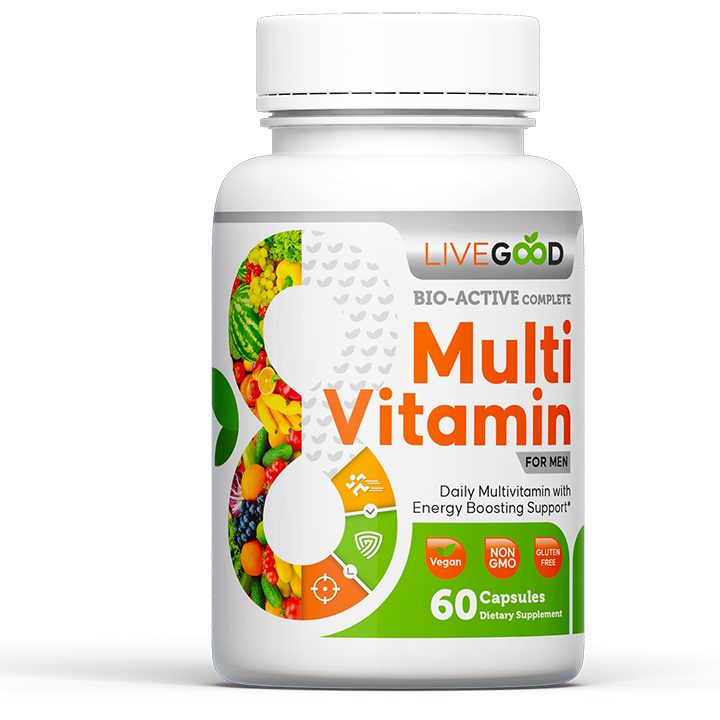
LiveGood Bio-Active Complete Multi-Vitamin For Men is a daily multivitamin strategically formulated with 24 vitamins and minerals at optimal dosages to help fill common nutritional gaps in men's everyday diets. It includes methylcobalamin, the active form of B-12, for an energy boost, so it is best taken in the morning with food. Follow the label directions. It is $12.95 for members versus $19.95 retail, supporting LiveGood's mission to "Provide the highest quality supplements in the world, at the lowest prices possible."
Frequently Asked Questions
What vitamins should men take daily?
Men should take only the vitamins needed to cover gaps that food, sunlight or an individualized medical plan does not address. Vitamin D is often worth checking, while B12 may matter for vegan men and some older adults. Magnesium and fibre also deserve attention, although neither is a vitamin. Use diet review, label reading and appropriate testing instead of assuming every man needs the same stack.
Do men need a multivitamin?
No, every man does not need a multivitamin. A varied diet may provide most essential nutrients, but a well-designed formula can offer convenient nutritional support when meals are inconsistent or certain food groups are missing. Choose moderate amounts, avoid unnecessary iron and check for overlap with other supplements. A multivitamin supports your routine, but it does not replace balanced meals or fibre-rich foods.
Should men take iron supplements?
Most men should not take iron supplements unless a doctor confirms a need. Men usually have lower routine iron losses, while excess iron can accumulate in the body. Haemochromatosis, an inherited iron overload condition, makes casual supplementation especially risky. If you have low iron results, unexplained fatigue, a family history of haemochromatosis or possible blood loss, talk to your doctor before taking iron.
What is the most common deficiency in men?
Vitamin D is one of the most commonly identified nutrient deficiencies in men, but there is no single answer for every age, diet or location. Sun exposure, skin pigmentation, season and food intake all affect risk. Magnesium and fibre are also common dietary shortfalls, though low intake is not the same as a diagnosed deficiency. A vitamin D blood test can provide a clearer answer than symptoms alone.
Do men need more magnesium?
Adult men generally have a higher recommended magnesium intake than adult women, but that does not mean every man needs a supplement. First look at foods such as nuts, seeds, beans, whole grains and leafy greens. If your intake remains low, discuss an appropriate supplement with a clinician and follow its label. Men with kidney conditions or those taking prescription medication should talk to their doctor first.