






HMB mainly helps your body limit muscle protein breakdown. That anti-catabolic effect, meaning it slows tissue loss, may help preserve muscle during hard training, inactivity, aging, or calorie restriction. The benefit depends heavily on your circumstances, so here is what HMB does, who tends to respond, and where the evidence remains uncertain.
Key Takeaways
- HMB is made from leucine: Your body produces a small amount of HMB while processing this essential amino acid.
- Its main role is protective: HMB appears to limit muscle protein breakdown more than it directly drives new muscle growth.
- Results depend on the person: Untrained adults, older people, and those facing inactivity or an energy deficit may have more room to benefit.
- Experienced lifters should be cautious: Studies in trained athletes are inconsistent, and unusually large early findings have not been reliably reproduced.
- Three grams is widely studied: Research commonly uses 3 grams daily, while timing appears less important than consistent use and appropriate training.
What HMB Is and Where It Comes From
HMB stands for beta-hydroxy beta-methylbutyrate. It is a compound your body makes when it breaks down leucine, one of the essential amino acids found in dietary protein. Essential means your body cannot make leucine on its own, so you need to get it through foods such as meat, dairy, eggs, soy, and legumes.
Leucine is well known for helping signal muscle protein synthesis, the process used to build and repair muscle proteins. Only a small portion of leucine follows the metabolic pathway that produces HMB. Eating more leucine does not necessarily create the same HMB exposure used in supplement studies, which is why HMB is also sold as a separate ingredient.
HMB is not a hormone, steroid, or stimulant. You should not expect an immediate energy boost or a dramatic change in how a workout feels. Its potential value is quieter. It may help protect muscle tissue when the body is under unusual physical stress or is receiving less of the training, movement, protein, or energy it normally needs.
That distinction matters. HMB is often marketed as a direct muscle builder, but the research does not support a simple promise that taking it will add muscle. Its effects appear to depend on whether muscle breakdown is elevated and how much room you have to improve.

HMB is a natural metabolite produced when the body processes the essential amino acid leucine.
The Anti-Catabolic Mechanism
Muscle is always being remodeled. Your body builds muscle proteins through muscle protein synthesis and removes damaged or unneeded proteins through muscle protein breakdown. Gaining muscle requires the balance to favor building over time. Losing muscle happens when breakdown repeatedly exceeds synthesis.
HMB appears to act mainly on the breakdown side of that equation. This is called an anti-catabolic effect. Catabolism is the process of breaking larger tissues or molecules into smaller parts. Anti-catabolic does not mean that breakdown stops completely. Normal protein turnover is necessary. Instead, HMB may help keep excessive breakdown in check during periods of stress.
One pathway involved is the ubiquitin-proteasome system. Think of it as part of the cell's protein disposal machinery. Proteins marked with a small tag called ubiquitin are directed to the proteasome, where they are dismantled. Laboratory and human research suggests HMB may reduce excessive activity in this system under some catabolic conditions. It may also influence cell repair, muscle cell membranes, and signals involved in protein synthesis.
HMB can affect building signals such as mTOR, a cellular pathway that responds to nutrients and exercise. However, this does not make HMB equivalent to protein, leucine, or resistance training. Its more consistent practical role appears to be muscle preservation, not forcing rapid growth.
This mechanism explains why context matters. If breakdown is already well controlled through training, adequate calories, protein, and recovery, adding HMB may have little visible effect.

HMB appears to work mainly by helping limit excessive muscle protein breakdown during physical stress.
Who Shows the Clearest Results
HMB tends to look most useful when muscle breakdown is likely to be elevated. One example is a beginner starting resistance training. A new program can create more muscle damage than the same workout would cause in an experienced lifter. Some studies in untrained adults have found modest improvements in lean mass or strength, although results are not uniform.
Older adults are another frequently studied group. Aging can make it harder to maintain muscle, especially when activity and protein intake decline. A 2022 review of controlled trials found that HMB may support muscle mass and some measures of physical function in older adults, but effects varied by study. HMB should not be viewed as a replacement for resistance exercise, adequate food, or dietary protein.
Periods of bed rest, injury-related inactivity, or hospitalization can also create a strong muscle-loss signal. Research in these settings suggests HMB may help reduce losses in some people. Evidence is still limited, and anyone dealing with an illness, injury, or existing medical condition should talk to a doctor before using it.
Calorie restriction is another plausible use. When you consistently eat less energy than you burn, preserving muscle becomes more difficult. HMB may provide some support, particularly if protein intake or training quality is not ideal. Still, it cannot compensate for an extreme diet or poor recovery.
Possible benefits also include smaller changes in muscle-damage markers or post-exercise recovery. These outcomes are inconsistent, and lower laboratory markers do not always translate into less soreness or better performance.

Older adults, beginners, and people experiencing inactivity may have more room to benefit from HMB.
Trained Lifters: A Weaker Case
If you already train consistently, eat enough protein, and manage recovery well, HMB has a weaker case. Your muscles have adapted to regular exercise, so the same session usually causes less unusual damage than it would for a beginner. That leaves less excessive breakdown for an anti-catabolic ingredient to influence.
Reviews of HMB research in trained adults generally find mixed or small effects. A review of the evidence noted substantial differences among studies, including training plans, participant experience, supplement form, diet control, and research quality. Some trials report better body composition, strength, or recovery. Others find no meaningful advantage over training alone.
This area also has a credibility problem worth acknowledging. Several influential early studies reported unusually large gains in lean mass and strength among trained participants. Those findings attracted attention because the changes were much larger than sports nutrition research would normally predict. Critics have questioned aspects of the methods, transparency, and biological plausibility, while later independent trials have often failed to reproduce the same magnitude of benefit.
That does not prove HMB is useless. It means dramatic claims should not guide your expectations. For an experienced lifter, consistent progressive training, enough calories, sufficient protein, sleep, and creatine have stronger practical foundations. HMB may be more reasonable during an unusually demanding training block, a cutting phase, or a return from inactivity, but even in those situations the added effect may be subtle.
Track performance and recovery over several weeks rather than judging HMB by soreness after one workout.
Experienced lifters often see smaller and less consistent HMB results than untrained adults.
Dose, Forms and Timing
Most HMB studies use 3 grams per day. That is research context, not a personalized dosing instruction. Follow the directions on your supplement label, and do not assume that taking more will produce a larger effect.
HMB supplements usually come in two forms. Calcium HMB, often written as HMB-Ca, binds HMB to calcium and is the more established form in the research literature. HMB free acid, written as HMB-FA, does not use the calcium salt. It may enter the bloodstream faster, but evidence that it produces meaningfully better long-term results is not convincing.
Some research divides the daily amount across multiple servings, while other products provide it at once. HMB is not a stimulant, and there is no well-established pre-workout window required for it to work. Taking it near exercise may be convenient, but consistency is probably more relevant than whether you take it 30 or 90 minutes before training.
Use HMB as part of a routine rather than a quick fix. Resistance exercise gives your muscles a reason to adapt. Dietary protein supplies amino acids for repair. Enough food and sleep support recovery. HMB may complement those basics, but it does not replace them.
For a fuller look at tolerability, daily use, and situations that call for extra caution, see does HMB have negative side effects?. Talk to your doctor before use if you are pregnant or breastfeeding, take prescription medication, have kidney or liver concerns, or manage an existing medical condition.
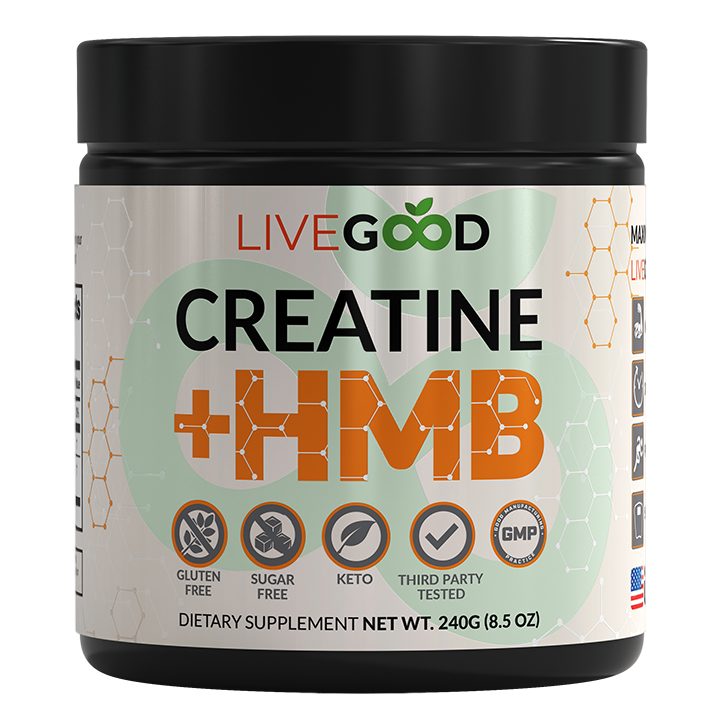
LiveGood Creatine + HMB provides 5 grams of creatine monohydrate plus 3 grams of HMB per serving, with no junk fillers, flavors, or additives. The formula supports muscle energy, healthy cognitive function, normal heart function, and muscle maintenance as you age. It is $19.95 for members versus $34.95 retail, reflecting LiveGood's goal of making straightforward wellness products more accessible through membership.
HMB Alongside Creatine
HMB and creatine do different jobs. HMB mainly aims to limit excessive muscle protein breakdown. Creatine increases the muscle's stored phosphocreatine, which helps rapidly regenerate ATP. ATP is the immediate energy currency your muscles use during short, intense efforts such as lifting, jumping, or sprinting.
Creatine has a much larger and more consistent evidence base for improving strength, training capacity, and lean mass when combined with resistance exercise. If you are choosing only one ingredient for general strength training, creatine monohydrate is usually the more evidence-supported starting point. HMB is not better than creatine, and combining them does not guarantee greater gains.
There is still a reasonable rationale for using both. Creatine may help you perform more high-quality work, while HMB may help limit breakdown when training stress, inactivity, aging, or calorie restriction makes muscle preservation harder. Because the mechanisms differ, taking them together is not inherently redundant.
The limitation is that combination studies do not always show whether HMB adds a meaningful benefit beyond creatine alone. Research results also vary by training status and study quality. A combined product may be convenient if you already intend to use the research-standard amounts of both ingredients, but convenience should not be mistaken for proof of synergy.
Give the basics priority. Train progressively, eat enough protein, recover well, and follow label directions. Supplements can support that system, but the system is what produces most of the result.
Frequently Asked Questions
What does HMB do to the body?
HMB primarily helps limit excessive muscle protein breakdown. Your body naturally makes it from leucine, but supplements provide a larger amount than food typically produces through normal metabolism. HMB may be most useful during unfamiliar training, aging, inactivity, or calorie restriction. It is less likely to produce a noticeable benefit in well-trained people who already eat and recover well.
How does HMB work?
HMB works mainly by influencing cellular pathways that control muscle protein breakdown. It may reduce excessive activity in the ubiquitin-proteasome system, part of the cell's protein disposal process, while also affecting repair and protein-building signals. The practical effect is mostly protective. HMB does not switch off normal breakdown or replace the stimulus and nutrients needed to build muscle.
Does HMB actually work?
HMB can work in certain situations, but its effects are usually modest and research findings are mixed. Beginners, older adults, and people facing inactivity or an energy deficit appear more likely to benefit. Results in experienced lifters are inconsistent, and several unusually positive early studies have been criticized. It should not be treated as a guaranteed muscle-building supplement.
What is HMB good for?
HMB may be useful for supporting muscle maintenance when the risk of muscle loss or damage is elevated. Examples include beginning a demanding exercise program, reducing calories, returning after inactivity, or trying to maintain muscle with age. Some studies also examine recovery and physical function, but results vary. Resistance training, adequate protein, food, and sleep remain more important.
Should you take HMB with creatine?
You can take HMB with creatine because they work through different mechanisms, but combining them is optional. Creatine has stronger evidence for supporting strength and high-intensity exercise, while HMB focuses more on limiting muscle breakdown. The pairing may make sense during stressful training or muscle-preservation periods, although research has not consistently shown that HMB adds substantial benefits beyond creatine alone.