
Creatine With HMB vs Creatine Monohydrate
 Written by Ben Glinsky
Ask AI about this article and Creatine + HMB





Creatine with HMB is not automatically better than creatine monohydrate. It is usually creatine monohydrate with a separate compound called HMB added, and that addition may be useful for some people but unnecessary for others. Here is what each ingredient does, where the evidence is strongest, and how to choose.
Key Takeaways
- The comparison is misleading: Creatine HMB is generally creatine monohydrate plus HMB, not a rival form of creatine.
- Monohydrate remains the default: It has decades of evidence for supporting strength, power, training performance, and lean mass gains.
- HMB may add targeted support: Its evidence is strongest among older adults, beginners, and people facing demanding training or low activity.
- Experienced lifters may notice less: Research on HMB in well-trained athletes is thinner and more mixed.
- Daily consistency matters most: Timing is flexible, so follow the label and choose a routine you can maintain.
They Are Not Two Forms of Creatine
The phrase creatine HMB makes the comparison sound like you are choosing between two types of creatine. In most products, that is not what is happening. Creatine monohydrate is the creatine ingredient. HMB is a separate compound added to it.
Creatine monohydrate consists of creatine attached to one water molecule. It is the form used in the overwhelming majority of creatine research. HMB stands for beta-hydroxy beta-methylbutyrate. Your body produces small amounts of HMB when it processes leucine, an essential amino acid found in protein-rich foods.
That means the useful question is not whether creatine HMB or monohydrate is the superior form. The real question is whether you are likely to benefit from adding HMB to an effective daily serving of creatine monohydrate.
Creatine with HMB usually combines two separate ingredients rather than introducing a new form of creatine.
This distinction also helps you read supplement labels. Check whether the product lists creatine monohydrate and HMB as two separate ingredients, along with the amount of each. Avoid assuming that a larger total scoop automatically provides a full creatine serving. Flavors, sweeteners, and other ingredients can account for some of that weight.
Other products may use creatine hydrochloride, often shortened to HCl, but that is a true alternative creatine form. You can see how it differs in our creatine HMB vs HCl comparison. For most people, monohydrate is still the sensible starting point because it is well studied, effective, widely available, and usually affordable.
What Creatine Monohydrate Does
Creatine helps your cells recycle adenosine triphosphate, or ATP. ATP is the immediate energy source your muscles use to contract. During lifting, sprinting, jumping, and other brief high-intensity efforts, that energy is used quickly. Increasing muscle creatine stores can help your body regenerate it faster between efforts.
In practical terms, creatine may help you complete slightly more work, maintain power across repeated sets, or progress your training over time. Those small improvements can support greater strength and lean mass gains when creatine is paired with resistance training and adequate food. Some early weight gain is water stored inside muscle cells, not instant new muscle tissue.

Creatine monohydrate supports the rapid energy recycling used during lifting, sprinting, and other intense efforts.
Creatine monohydrate has been studied in women and men, younger athletes, and older adults. A peer-reviewed International Society of Sports Nutrition position stand describes monohydrate as the most extensively studied and clinically effective creatine form for improving high-intensity exercise capacity and lean body mass during training.
Research is also exploring creatine in relation to cognition and the energy needs of the brain. Results can depend on age, diet, sleep, and baseline creatine intake. Vegetarians and vegans may start with lower dietary creatine intake because creatine occurs mainly in meat and fish, although individual responses still vary.
Creatine does not replace progressive training, protein, calories, sleep, or recovery. You also may not feel it working like a stimulant. Its value comes from gradually increasing creatine stores and supporting repeated training quality. That is why consistent daily use matters more than finding a perfect pre-workout minute.
What HMB Adds, If Anything
HMB is produced when the body metabolizes leucine, but only a small share of leucine becomes HMB. Supplemental HMB is intended to provide a more predictable amount than the body would ordinarily make from food.
Research on HMB has focused largely on muscle protein turnover. Turnover is the continuous process of breaking down old proteins and building new ones. HMB may help support the balance between these processes, particularly when the body is adapting to unfamiliar exercise, reduced activity, or greater physical stress.
The strongest evidence tends to involve people who are new to resistance training, older adults, or people going through periods when maintaining muscle is more challenging. Some studies report improvements in lean mass, strength, or recovery measures. However, studies differ in training programs, participant age, HMB form, diet, and duration, so results are not uniform.

Research on HMB is most encouraging for beginners, older adults, and people adapting to new physical demands.
Evidence is thinner and more mixed in experienced lifters. A trained person has already adapted to the muscle stress caused by regular exercise. That may leave less room for HMB to create a noticeable difference. Claims that HMB reliably produces dramatic extra growth or eliminates soreness go beyond what the research supports.
HMB also is not a testosterone booster. There is no solid evidence that raising testosterone is its main action or a dependable result of taking it. Its proposed role is related to muscle protein turnover, not hormone replacement.
If you are comparing HMB with amino acid blends, remember that they are not interchangeable. HMB is a leucine metabolite, while branched-chain amino acids provide leucine, isoleucine, and valine. Our HMB vs BCAA comparison explains when either might fit.
Taking Them Together
Most healthy adults can take creatine monohydrate and HMB together when they follow the product label. They work through different pathways. Creatine supports rapid cellular energy recycling, while HMB may support muscle protein balance. Combining them does not turn HMB into a new form of creatine.
The harder question is whether the combination produces meaningfully better results than creatine alone. Some studies suggest the pairing may support strength, body composition, or exercise performance in certain groups. Other research does not show a clear extra benefit. There is not enough consistent evidence to say that everyone will gain more muscle from the combination.

Creatine and HMB can be taken together, but the added value of HMB depends on the person and training context.
Your training history can guide the decision. If you are starting resistance training, returning after time away, or trying to support muscle function as you age, HMB may be a reasonable addition. If you are a trained lifter who already eats enough protein and follows a well-designed program, plain creatine monohydrate may provide most of the supplement benefit you are likely to notice.
Budget matters too. Creatine monohydrate alone is usually the lower-cost choice. Paying more for HMB makes sense only if you value its possible additional support and the product supplies meaningful, clearly labeled amounts. It should not come at the expense of food quality, enough protein, or a consistent training plan.
Both ingredients are generally well tolerated in research. Creatine may cause temporary water-weight gain or digestive discomfort, especially when a large amount is taken at once. HMB can occasionally cause mild digestive symptoms. If discomfort occurs, stop using the supplement and speak with a healthcare professional rather than increasing or changing the serving on your own.
Dosing and Timing in Practice
Creatine works by gradually saturating, or filling, muscle creatine stores. Common research protocols use 3 to 5 grams of creatine monohydrate daily. Some studies use a short loading phase with larger divided amounts, but loading is optional and can increase the chance of digestive discomfort. Follow your product's label rather than copying a study protocol.
HMB research commonly uses a total of 3 grams per day. Depending on the product, that amount may come in one serving or be divided. Different forms of HMB exist, so follow the specific directions on the label instead of assuming all products are used identically.
A consistent label-directed routine matters more than taking creatine and HMB at a precise time.
There is no firmly established perfect time to take the combination. Taking it near a workout is convenient, but consistency is more important than whether you use it before or after training. On rest days, continue according to the label. Pairing the serving with a regular meal, smoothie, or training routine can make it easier to remember.
Mix powder thoroughly with the amount of liquid listed on the package. If a full serving upsets your stomach, do not exceed or redesign the directions yourself. Ask a healthcare professional whether the product is appropriate for you.
Talk to your doctor before using creatine, HMB, or a combination if you take prescription medications, are pregnant or breastfeeding, have a kidney or liver condition, or have another existing medical condition. Supplements should support a routine, not replace balanced meals, appropriate exercise, hydration, or medical care.
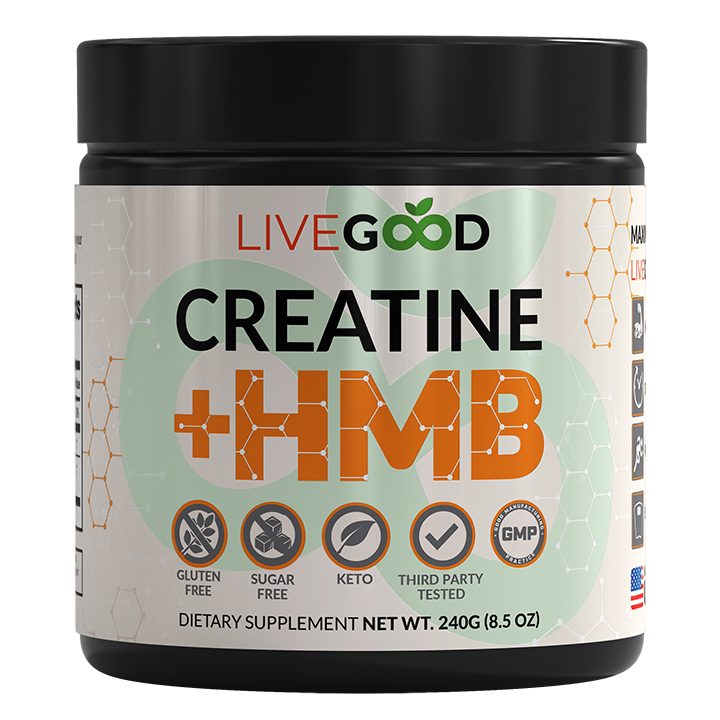
LiveGood Creatine + HMB provides 5 grams of creatine monohydrate plus 3 grams of HMB per serving, with nothing else, no junk fillers, flavors, or additives. It supports cellular energy in the muscles, brain, and heart while helping maintain muscle and cognitive function with age. Follow the label for a consistent daily serving. It is $19.95 for members versus $34.95 retail, supporting LiveGood's mission to "Provide the highest quality supplements in the world, at the lowest prices possible."
Frequently Asked Questions
Is creatine HMB better than creatine monohydrate?
Creatine with HMB is not clearly better for everyone. It generally contains creatine monohydrate plus an additional ingredient that may support muscle protein balance. HMB appears most promising for older adults, beginners, and people returning to training. Experienced lifters may get little extra benefit, making plain monohydrate the more practical and evidence-backed default.
Can you take HMB and creatine together?
Yes, most healthy adults can take HMB and creatine together as directed on the label. The ingredients act differently, and research has examined them in combination. Talk to your doctor first if you use prescription medication, are pregnant or breastfeeding, have kidney or liver concerns, or live with another medical condition.
When should you take HMB and creatine?
You can take HMB and creatine at any consistent time that follows the product directions. Using them around a workout may be convenient, but evidence does not establish one essential timing window. Daily consistency matters more because creatine works by building muscle stores over time. Continue according to the label on rest days as well.
What is creatine with HMB?
Creatine with HMB is a combination of creatine, usually creatine monohydrate, and beta-hydroxy beta-methylbutyrate. Creatine supports rapid energy recycling during intense activity. HMB is a metabolite of leucine studied for its role in muscle protein turnover. It is a two-ingredient combination, not a special molecular form of creatine.
Is HMB worth adding to creatine?
HMB may be worth adding if you are older, new to resistance exercise, returning after a break, or want additional support during a demanding period. The case is less convincing for experienced lifters with strong nutrition and training habits. Compare the labeled amounts and price, then treat HMB as optional rather than necessary.