
How to Make Perfume Using Essential Oils
 Written by Nauder Khazan
Ask AI about this article and Essential Oils (Therapeutic Grade)





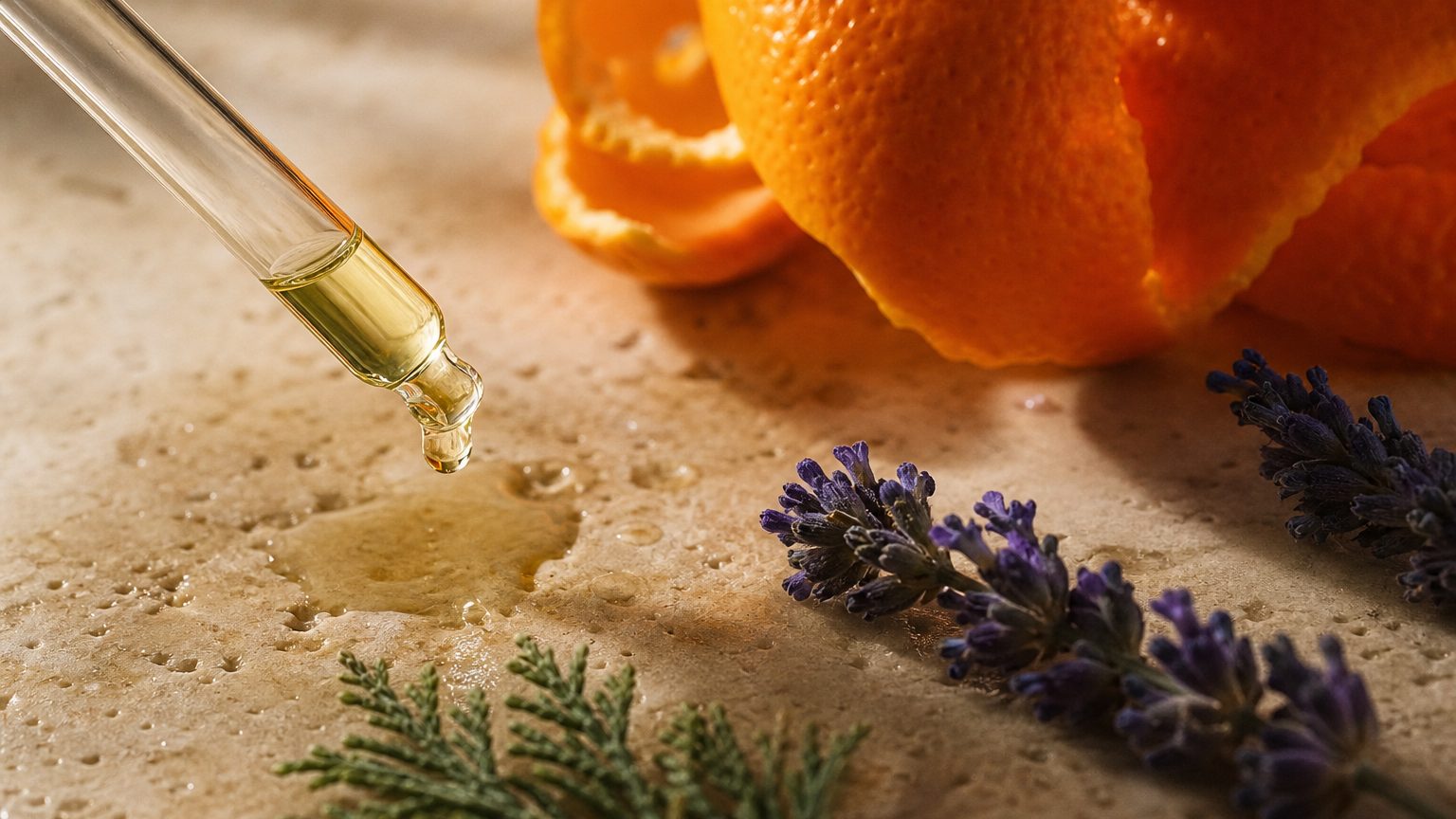
To make perfume using essential oils, blend a small aromatic concentrate, dilute it in carrier oil or perfumer's alcohol, and let the finished perfume rest before testing it on your skin. The best results come from measuring carefully, respecting each oil's topical limit, and adjusting the blend gradually rather than adding more oil all at once.
Key Takeaways
- Choose your base: Carrier oil creates a close-wearing roll-on, while perfumer's alcohol produces a lighter spray.
- Measure precisely: A small scale or graduated pipette gives you more repeatable results than counting drops.
- Build in layers: Combine top, middle, and base notes to give the fragrance shape and staying power.
- Respect skin limits: Follow the label and the lowest applicable dermal limit for every oil in your blend.
- Allow resting time: Essential oil perfumes usually smell more integrated after several days or weeks.
Understand Essential Oil Perfume
Essential oil perfume is a diluted blend of aromatic plant oils designed for personal fragrance. Distillation or cold pressing captures volatile aromatic compounds, meaning compounds that evaporate readily and reach your nose. These materials can smell complex, but they do not behave exactly like the synthetic aroma chemicals used in many commercial perfumes.
That difference affects performance. An essential oil perfume may change noticeably over a few hours, stay closer to your skin, and vary slightly between botanical harvests. It may not reproduce the diffusion or all-day persistence of a designer fragrance. Adding excessive essential oil does not reliably solve that limitation and can make the perfume harsh or unsuitable for skin.
Perfumers commonly describe materials as top, middle, or base notes. Top notes create the first impression and tend to evaporate quickly. Citrus and some fresh herbal aromas often fall into this group. Middle notes form the heart of the fragrance, while heavier base notes such as woods and resins can remain noticeable longer.
These categories are useful rather than absolute. Lavender, for example, can bridge the top and middle of a composition. Your carrier, skin, climate, and the exact oil chemistry also affect what you smell. If you are new to aromatic products, review the broader principles for how to use essential oils before making a leave-on skin product.
Gather Your Perfume Supplies
Start with a clean glass bottle, blotting strips or plain paper, disposable pipettes, labels, and a notebook. Amber or cobalt glass helps reduce light exposure, although it does not replace storage in a cool, dark location. Use a small scale accurate to at least 0.01 gram if possible, since essential oil drops differ in size and weight.
For a roll-on perfume, choose a mild carrier oil with little aroma. Fractionated coconut oil and jojoba are common options. Jojoba is technically a liquid wax, and both options tend to interfere less with the fragrance than strongly scented culinary oils. Confirm that your chosen carrier is appropriate for cosmetic use.
For a spray, use perfumer's alcohol or another ethanol product specifically sold and labeled for fragrance making. Do not use rubbing alcohol or methanol. High-proof ethanol is highly flammable, so keep it away from flames, heat, sparks, and smoking, and work with ventilation.
Water alone cannot evenly dilute essential oils because oil and water separate. A water-based spray also raises preservation questions once microorganisms can grow in the formula. Shaking the bottle may temporarily disperse droplets, but it does not make the preparation properly solubilized or preserved. For a beginner project, an anhydrous formula, meaning one made without water, is simpler and more predictable.
Finally, check each essential oil's botanical name, extraction method, expiration guidance, and topical directions. Oils sold only for diffusion or household use should not automatically be placed in perfume.
Design a Balanced Scent
Build the aromatic concentrate before adding carrier oil or alcohol. Begin with three materials so you can understand what each one contributes. A simple starting structure is 20% to 30% top note, 40% to 60% middle note, and 20% to 30% base note, but this is a creative framework rather than a safety formula.
For example, you might explore a concentrate built from 20% sweet orange, 50% lavender, and 30% cedarwood. This describes the ratio inside the aromatic concentrate, not the percentage applied to skin. You must still check the exact oil's label and dermal limit. Different botanical species, extraction methods, and citrus varieties can have different restrictions.
Make a tiny test concentrate and record each addition by weight. Smell it first on a paper strip, then again after 15 minutes, several hours, and the next day. The opening tells you about the top notes, while later checks reveal whether the middle and base remain pleasant after the most volatile materials fade.
Change only one variable at a time. If the opening disappears too quickly, slightly reduce a dominant citrus note rather than immediately adding more total oil. If the blend feels heavy, adjust the ratio with a suitable brighter note. A base note can help a fragrance remain perceptible, but no natural ingredient guarantees long wear.
Avoid copying drop-based recipes without checking the oils involved. Ten drops of one oil may weigh considerably more than ten drops of another, and a recipe's overall percentage does not override an individual ingredient's skin limit.
Make the Perfume Step by Step
First decide whether you want a roll-on or a spray. A roll-on stays closer to the body and is easy to apply sparingly. An alcohol spray evaporates faster and usually gives the fragrance more initial lift.
-
Review every label. Confirm that each oil permits topical use and note any dilution, sunlight, or other warnings. The most restrictive applicable direction controls your formula.
-
Calculate the final concentration. For a 10 mL oil perfume at 2% total essential oil, the aromatic concentrate occupies 0.2 mL and the carrier occupies 9.8 mL. For a 30 mL alcohol perfume at 5%, the concentrate occupies 1.5 mL and alcohol occupies 28.5 mL. These are calculation examples, not universal recommendations. Use a lower amount if any label or ingredient-specific limit requires it.
-
Check each oil separately. If one oil makes up half of a 2% concentrate, its final concentration is 1%. A safe total percentage cannot be assumed unless every individual material also remains within its applicable limit.
-
Combine the concentrate. Measure your selected top, middle, and base notes into a small glass vial. Cap it and smell it from a blotter rather than repeatedly holding the open vial beneath your nose.
-
Add the base. Blend the concentrate into cosmetic-grade carrier oil for a roll-on or fragrance-grade alcohol for a spray. Cap tightly and rotate the bottle gently. Aggressive shaking adds bubbles but does not improve the formula.
-
Label the bottle. Record the ingredients, percentages, date, and batch number. Without notes, you cannot accurately reproduce a successful blend or identify what needs changing.
-
Let it rest. Store the closed bottle away from heat and direct light. Recheck it after 48 hours, then after one to two weeks. Alcohol blends may continue integrating for several weeks.
If you need ingredients for your test blend, LiveGood's Essential Oils are described as Therapeutic Grade Premium Essential Oils and are member $29.95 vs retail $69.95. They are Third Party Tested, Vegan, Cruelty Free, Non GMO, Gluten Free, Soy Free, Keto Friendly, and GMP Certified. Follow each oil's label, measure your concentrate, dilute it in carrier oil or fragrance-grade alcohol, and test the finished perfume cautiously before wider use.
Test and Refine Your Blend
Resting, sometimes called maceration in perfume making, gives the aromatic materials time to mix evenly with the base. It does not chemically transform every rough blend into a polished one, but the scent may become more cohesive as you evaluate it over time. Keep the bottle tightly closed so repeated air exposure does not speed oxidation.
Start with blotter testing. Write the formula code on the strip, apply a small amount, and record your impressions at consistent intervals. Useful checkpoints include the first minute, 15 minutes, two hours, and the next day. Compare only a few versions at once because your sense of smell adapts quickly.
After confirming that the formula follows all topical directions, perform a small patch test with the finished diluted perfume. Apply it to a limited area and wait before broader use. A patch test may reveal a problem, but it cannot guarantee that future irritation or sensitization will never occur. Sensitization is an immune response that can develop after repeated exposure.
If the scent feels unbalanced, revise a duplicate sample instead of altering your full bottle. Make small, recorded changes and let the new version rest again. If it smells muddy, simplify the formula. If it fades quickly, evaluate the note structure and base rather than exceeding topical limits.
Cloudiness in an alcohol perfume can come from waxes or other natural components in the oils. Sediment, a sharply changed odor, leaking packaging, or unexpected skin discomfort are reasons to stop using that batch and reassess the materials and storage.
Use Essential Oils Safely
Natural origin does not guarantee that an ingredient is gentle or suitable for unrestricted skin use. Essential oils are concentrated mixtures, and some can irritate skin, cause sensitization, or interact with sunlight. Never apply a perfume concentrate directly to your skin unless its specific label clearly permits that use.
Cold-pressed citrus oils deserve special attention. Certain expressed citrus oils can be phototoxic, meaning they may cause a skin reaction after ultraviolet exposure. The risk depends on the botanical material, extraction method, chemistry, concentration, and current safety standard. Steam-distilled and specially treated versions may have different limits, so do not assume that every oil with the same common name is interchangeable.
Oxidation also matters. Heat, light, air, and time can change essential oil components, sometimes increasing their potential to irritate sensitive skin. Buy quantities you can use within the supplier's stated period, close caps promptly, and discard oils that smell distinctly altered or show other signs of deterioration.
Keep perfume materials away from eyes, lips, damaged skin, children, and pets. Do not ingest a perfume blend. Ask your doctor before topical essential oil use if you are pregnant or breastfeeding, take prescription medication, have kidney or liver conditions, or have an existing medical condition. Ask a qualified clinician about anything involving children, and consult a veterinarian before using aromatic products around pets.
Stop use if the finished product causes burning, swelling, persistent redness, or other unexpected discomfort. Wash the area with mild soap and seek medical advice when appropriate. Following a recipe accurately cannot eliminate individual sensitivity.
Set Realistic Perfume Expectations
Essential oil perfume offers creative control over the aroma, carrier, and concentration, but it has practical limits. Many natural top notes disappear relatively quickly. Heavier woods, roots, and resins can extend the perceived drydown, yet they will not necessarily match the projection or persistence of commercial fragrance materials.
Skin also changes how perfume smells. Temperature, moisture, application area, clothing, and personal skin chemistry can affect evaporation and perception. Applying more is not always better, especially for a leave-on product. A restrained, well-balanced formula is usually more comfortable and easier to evaluate than an overloaded one.
Your first version may need several trials. Keep each batch small, document every measurement, and compare changes on blotters before making more perfume. Consistency creates useful information, while unrecorded adjustments make it difficult to identify why one version worked.
DIY perfume is best approached as a careful craft rather than a quick recipe. Respect ingredient limits, allow realistic resting time, and expect a softer, more variable fragrance than many conventional perfumes. That process gives you a repeatable method while preserving the character that made you choose essential oils in the first place.